




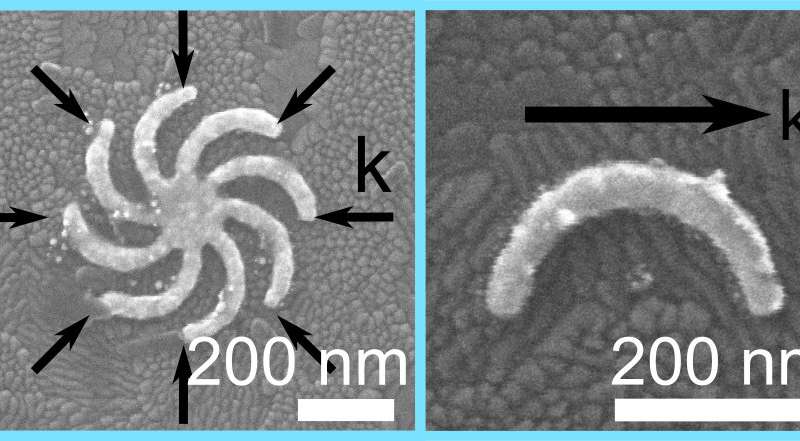
Rice University researchers have discovered a fundamentally different form of light-matter interaction in their experiments with gold nanoparticles.
They weren't looking for it, but students in the lab of Rice chemist Stephan Link found that exciting the microscopic particles just...

New research reveals why the "supermaterial" graphene has not transformed electronics as promised, and shows how to double its performance and finally harness its extraordinary potential.
Graphene is the strongest material ever tested. It's also flexible, transparent and conducts heat...

Inspired by Actinia, a sea organism that ensnares its prey with its tentacles, a team of researchers has developed a method for efficiently treating water.
The research, a collaboration of the labs of Yale's Menachem Elimelech and Huazhang Zhao of...

Today's optical systems—from smartphone cameras to cutting-edge microscopes—use technology that hasn't changed much since the mid-1700s. Compound lenses, invented around 1730, correct the chromatic aberrations that cause lenses to focus different wavelengths of light in different spots. While effective,...

Researchers at RMIT University have engineered a new type of transistor, the building block for all electronics. Instead of sending electrical currents through silicon, these transistors send electrons through narrow air gaps, where they can travel unimpeded as if...

Scientists from the University of Wollongong (UOW), working with colleagues at China's Beihang University, Nankai University, and Institute of Physics at Chinese Academy of Sciences, have successfully created an atomic scale, two-dimensional electronic kagome lattice with potential applications in...

With virtual reality (VR) sizzling in every electronic fair, there is a need for displays with higher resolution, frame rates and power efficiency. Now, a joint collaboration of researchers from SCALE Nanotech, Graphenea and TU Delft have used graphene...

Rice University scientists have built a better epoxy for electronic applications.
Epoxy combined with "ultrastiff" graphene foam invented in the Rice lab of chemist James Tour is substantially tougher than pure epoxy and far more conductive than other epoxy composites...

Scientists from the Center for Functional Nanomaterials (CFN)—a U.S. Department of Energy (DOE) Office of Science User Facility at Brookhaven National Laboratory—have dramatically improved the response of graphene to light through self-assembling wire-like nanostructures that conduct electricity. The improvement...
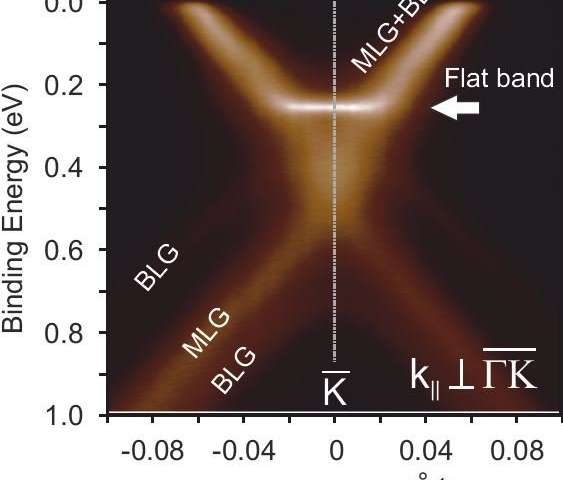
Scientists at HZB have found evidence that double layers of graphene have a property that may let them conduct current completely without resistance. They probed the band structure at BESSY II with extremely high resolution ARPES and could identify...
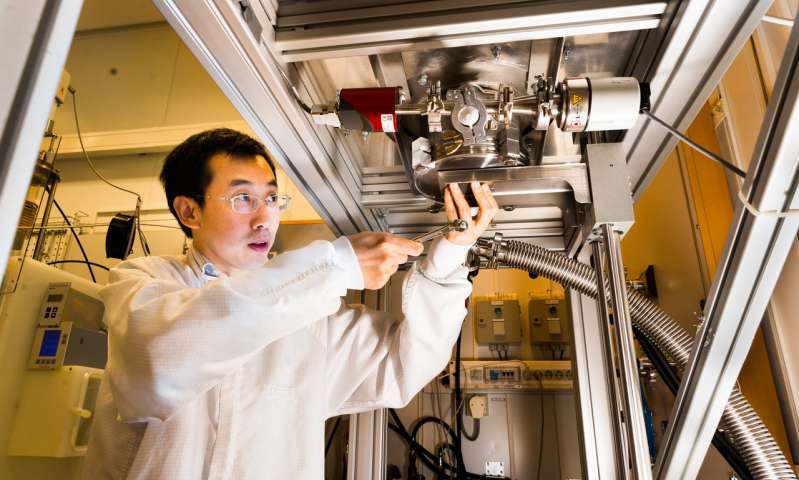
Using the energy from the sun and graphene applied to the surface of cubic silicon carbide, researchers at Linköping University, Sweden, are working to develop a method to convert water and carbon dioxide to the renewable energy of the...


