




Engineers have devised a fabric dressing whose thickness and elasticity can be custom-matched to specific areas of the body.
The material is able to be absorbed by the skin's own tissue as it heals.
Two synthetic materials are blended to produce nanometre-sized fibres—thousands...
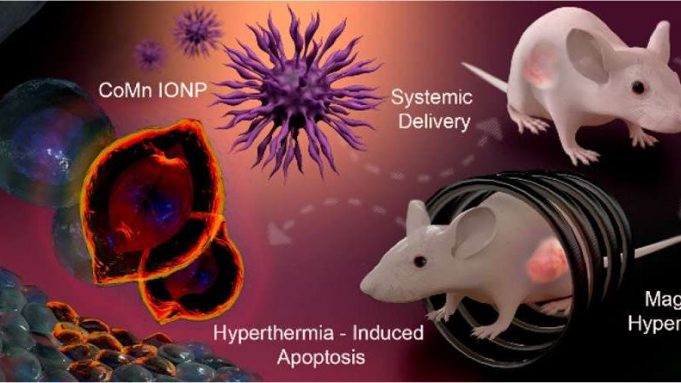
Researchers at Oregon State University have developed an improved technique for using magnetic nanoclusters to kill hard-to-reach tumors.
Magnetic nanoparticles—tiny pieces of matter as small as one-billionth of a meter—have shown anti-cancer promise for tumors easily accessible by syringe, allowing...

Everyday transitions from one state of matter to another—such as freezing, melting or evaporation—start with a process called "nucleation," in which tiny clusters of atoms or molecules (called "nuclei") begin to coalesce. Nucleation plays a critical role in circumstances...
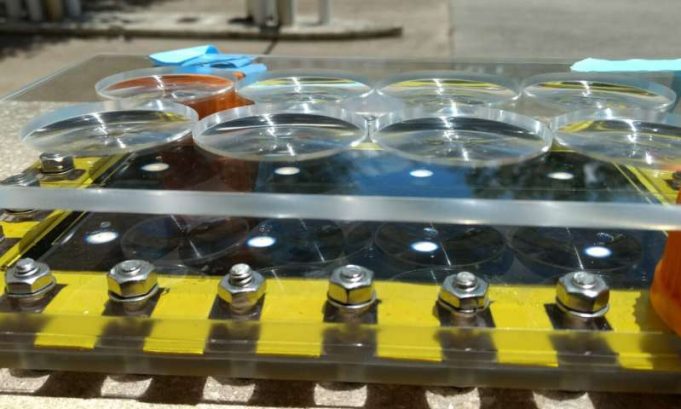
Rice University's solar-powered approach for purifying salt water with sunlight and nanoparticles is even more efficient than its creators first believed.
Researchers in Rice's Laboratory for Nanophotonics (LANP) this week showed they could boost the efficiency of their solar-powered desalination...
Investigators from Brigham and Women's Hospital are taking advantage of a unique phenomenon of nanoparticles to develop a test for early detection of different types of diseases, including cancer.
Through previous investigations, Morteza Mahmoudi, Ph.D., now a biomedical investigator in...
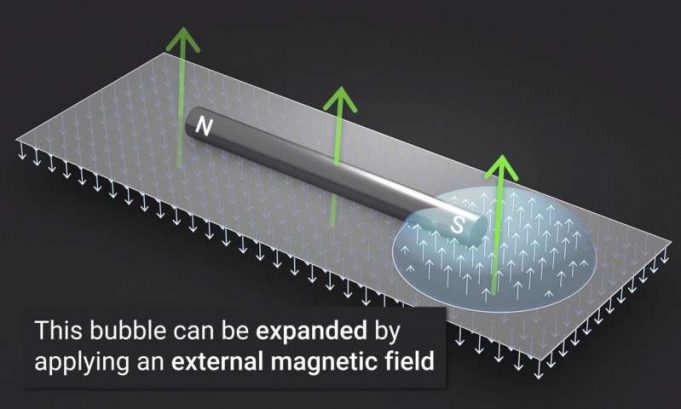
As if they were bubbles expanding in a just-opened bottle of champagne, tiny circular regions of magnetism can be rapidly enlarged to provide a precise method of measuring the magnetic properties of nanoparticles.
The technique, uncorked by researchers at the...

An international team of scientists is getting closer to perfecting molecule-sized motors that drill through the surface of cancer cells, killing them in an instant.
Researchers at Rice University, Durham (U.K.) University and North Carolina State University reported their success...
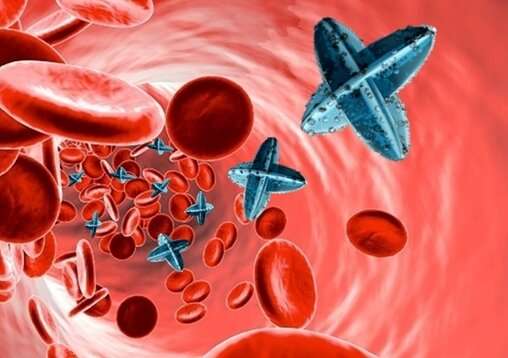
UNSW engineers have shown that micro-submarines powered by nano-motors could navigate the human body to provide targeted drug delivery to diseased organs without the need for external stimulus.
Cancers in the human body may one day be treated by tiny, self-propelled "micro-submarines"...

A new compound which visualises and kills antibiotic resistant superbugs has been discovered by scientists at the University of Sheffield and Rutherford Appleton Laboratory (RAL).
The team, led by Professor Jim Thomas, from the University of Sheffield's Department of Chemistry,...

What if the wood your house was made of could save your electricity bill? In the race to save energy, using a passive cooling method that requires no electricity and is built right into your house could save even...
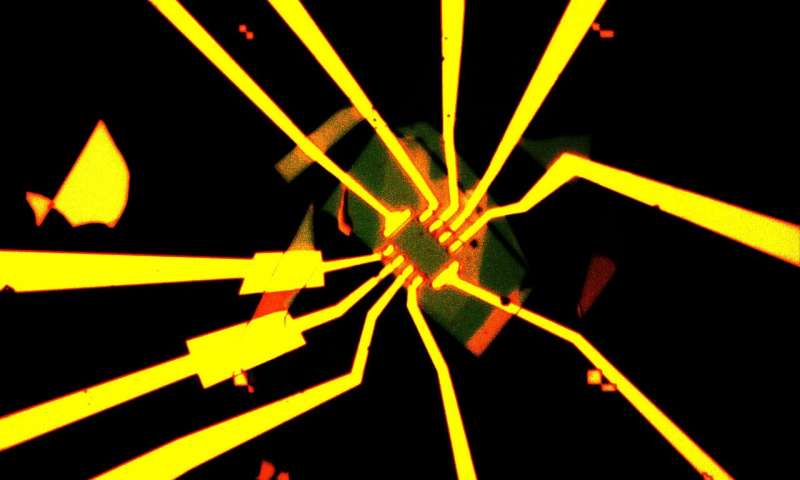
Semiconductors, which are the basic building blocks of transistors, microprocessors, lasers, and LEDs, have driven advances in computing, memory, communications, and lighting technologies since the mid-20th century. Recently discovered two-dimensional materials, which feature many superlative properties, have the potential...


