





Researchers from Washington State University and Tufts University have demonstrated for the first time that a single metal atom can act as a catalyst in converting carbon monoxide into carbon dioxide, a chemical reaction that is commonly used in...
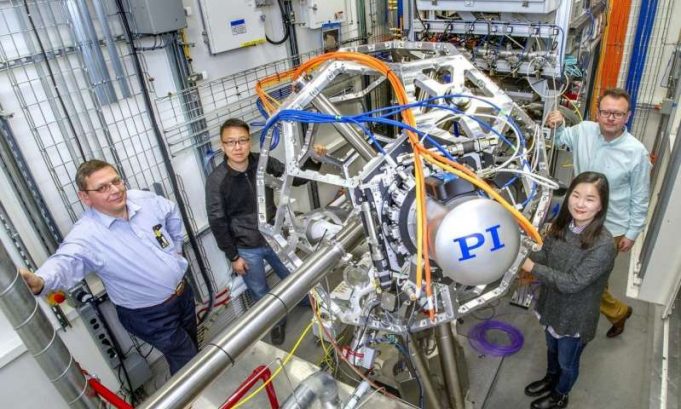
Imagine if carbon dioxide (CO2) could easily be converted into usable energy. Every time you breathe or drive a motor vehicle, you would produce a key ingredient for generating fuels. Like photosynthesis in plants, we could turn CO2 into molecules...

It is now possible to create complex, custom-designed transmembrane proteins from scratch, scientists report this week. The advance, led by molecular engineers at the University of Washington Institute for Protein Design, will enable researchers to create transmembrane proteins not...

New research published in Nature Methods will dramatically improve how scientists "see inside" molecular structures in solution, allowing for much more precise ways to image data in various fields, from astronomy to drug discovery.
The new method will allow for the visualization...

Peptides, short amino acid chains that control many functions in the human body, represent a billion-dollar market. But normally, peptide-based medications must be injected. A research team led by the Technical University of Munich (TUM) has now determined how...

ETH scientists have been able to prove that a protein structure widespread in nature – the amyloid – is theoretically capable of multiplying itself. This makes it a potential predecessor to molecules that are regarded as the building blocks...

Sipping wine is good for your colon and heart, possibly because of the beverage's abundant and structurally diverse polyphenols. Now researchers report in ACS' Journal of Agricultural and Food Chemistry that wine polyphenols might also be good for your oral health.
Traditionally,...

Using a state-of-the-art type of electron microscopy, an MIT-led team has discovered the structure of an enzyme that is crucial for maintaining an adequate supply of DNA building blocks in human cells.
Their new structure also reveals the likely mechanism...

Electrically conductive films that are optically transparent have a central role in a wide range of electronics applications, from touch screens and video displays to photovoltaics. These conductors function as invisible electrodes for circuit wiring, touch sensing, or electrical...

On the cellular highway, motor proteins called dyneins rule the road. Dyneins "walk" along structures called microtubules to deliver cellular cargo, such as signaling molecules and organelles, to different parts of a cell. Without dynein on the job, cells...

It all comes down to metal-organic frameworks (MOFs), an amazing next generation material that have the largest internal surface area of any known substance. The sponge like crystals can be used to capture, store and release chemical compounds. In...


