





A new type of energy storage system could revolutionise energy storage and drop the charging time of electric cars from hours to seconds.
In a new paper published today in the journal Nature Chemistry, chemists from the University of Glasgow...

eHow water solvates and transports protons is a fundamental question facing chemists and biologists alike and is vital to our understanding of processes such as photosynthesis and cellular respiration.
A team of researchers at the University of Chicago used broadband...

Blue light from digital devices and the sun transforms vital molecules in the eye's retina into cell killers, according to optical chemistry research at The University of Toledo.
The process outlined in the study, which was recently published in the...

In India and other countries in Southeast Asia, curcumin is often used as a spice in cooking, particularly chicken or fish. It is known for its therapeutic effect and as a way to kill germs present in raw meat....

An artificial-intelligence approach created at the University of North Carolina at Chapel Hill Eshelman School of Pharmacy can teach itself to design new drug molecules from scratch and has the potential to dramatically accelerate the design of new drug...

A new tool is drastically changing the face of chemical research – artificial intelligence. In a new paper published in Nature, researchers review the rapid progress in machine learning for the chemical sciences.
Almost every technological advance in human history...
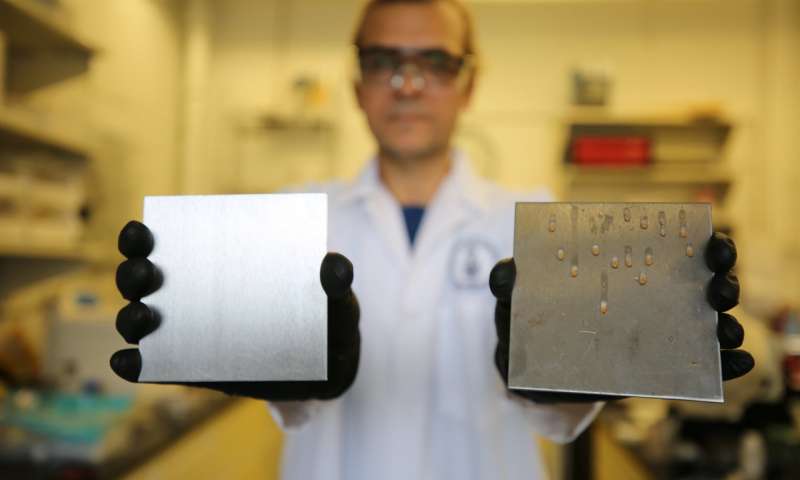
Many foods produced on an industrial scale include raw ingredients mixed together in enormous stainless steel machines that can be difficult to clean. With repeated use, equipment surfaces get minute scratches and grooves, providing bacteria and biofilms the perfect...

Scientists have developed a pioneering new technique that could unlock new methods of making solar energy more efficient.
A team of experts from the University of Exeter has discovered an innovative way for generating photovoltaic (PV) energy – or ways...

In 1924, Russian biochemist Alexander Oparin claimed that life on Earth developed through gradual chemical changes of organic molecules, in the "primordial soup" which likely existed on Earth four billion years ago. In his view, the complex combination of...

Researchers have identified a group of materials that could be used to make even higher power batteries. The researchers, from the University of Cambridge, used materials with a complex crystalline structure and found that lithium ions move through them...

Metallic hydrogen is one of the rarest materials on Earth, yet more than 80 percent of planets—including Jupiter, Saturn, and hundreds of extrasolar planets—are composed of this exotic form of matter.
Its abundance in our solar system—despite its rarity on...


