




Researchers have discovered a network of channels inside bacterial communities which could be used to kill bacteria more quickly by 'tricking' them into transporting drugs.
The communities—called biofilms—are involved in up to 80% of persistent human infections and cannot be...

Researchers from the Okinawa Institute of Science and Technology Graduate University (OIST) have shed light on the reproductive role of 'dark matter' DNA—non-coding DNA sequences that previously seemed to have no function.
Their findings, published today in Nature Communications, have revealed...

Soap bubbles facilitated the pollination of a pear orchard by delivering pollen grains to targeted flowers, demonstrating that this whimsical technique can successfully pollinate fruit-bearing plants. The study, from the Japan Advanced Institute of Science and Technology in Nomi,...
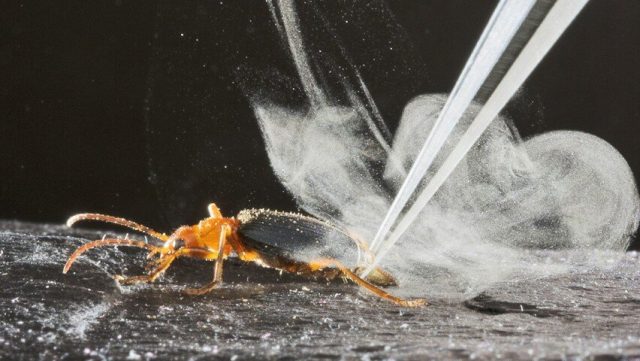
If you want to see one of the wonders of the natural world, just startle a bombardier beetle. But be careful: when the beetles are scared, they flood an internal chamber with a complex cocktail of aromatic chemicals, triggering...

Ever wonder how land animals like humans evolved to become smarter than their aquatic ancestors? You can thank the ground you walk on.
Northwestern University researchers recently discovered that complex landscapes—dotted with trees, bushes, boulders and knolls—might have helped land-dwelling animals evolve...
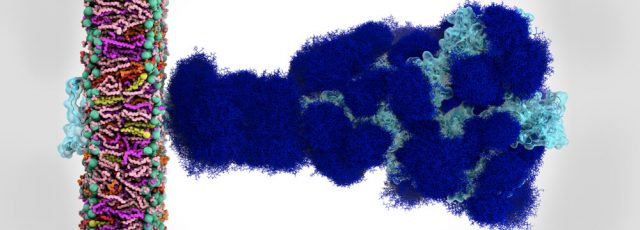
They say you can't judge a book by its cover. But the human immune system does just that when it comes to finding and attacking harmful microbes such as the coronavirus. It relies on being able to recognize foreign...

Everyone knows it: An entire box of Girl Scout cookies counts as one serving, right?
That's at least how it feels, and a University of Michigan study in fruit flies finds why this might be: a high-sugar diet muddies the neural circuit that allows you to...

Amongst the world's most challenging problems is the need to feed an ever-growing global population sustainably.
Securing the food supply is of paramount importance, and more attention must be given to the threat from fungal pathogens competing with us for our own...

Human eggs use chemical signals to attract sperm. New research from Stockholm University and Manchester University NHS Foundation Trust shows that eggs use these chemical signals to choose sperm. Different women's eggs attract different men's sperm—and not necessarily their...

New evidence identifies 64 pesticide residues in milkweed, the main food for monarch butterflies in the west. Milkweed samples from all of the locations studied in California's Central Valley were contaminated with pesticides, sometimes at levels harmful to monarchs...

Our lungs, bones, blood vessels and other major organs are made up of cells, and one way our bodies keep us healthy is by using protein messengers known as ligands that bind to receptors on the surfaces of cells...


