




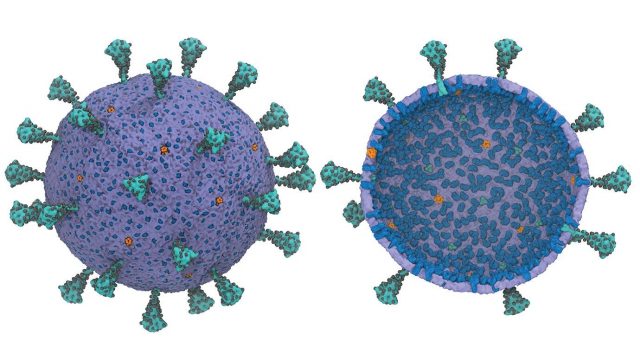
Researchers at the University of Chicago have created the first usable computational model of the entire virus responsible for COVID-19—and they are making this model widely available to help advance research during the pandemic.
"If you can understand how a...

A new study in the Oxford Economic Papers finds that migration flows the last 500 years from high sunlight regions to low sunlight regions influence contemporary health outcomes in destination countries.
The researchers here noted that people's ability to synthesize vitamin D...

Starting as a single cell, organisms undergo millions of generations of divisions to ultimately generate the bones, heart, brain and other components that make up a living being. The mainspring within this intricate process is the transfer of DNA...

Step into your new, microscopic time machine. Scientists at the University of Colorado Boulder have discovered that a type of single-celled organism living in modern-day oceans may have a lot in common with life forms that existed billions of...

Researchers in Japan have made the first observations of biological magnetoreception—live, unaltered cells responding to a magnetic field in real time. This discovery is a crucial step in understanding how animals from birds to butterflies navigate using Earth's magnetic...
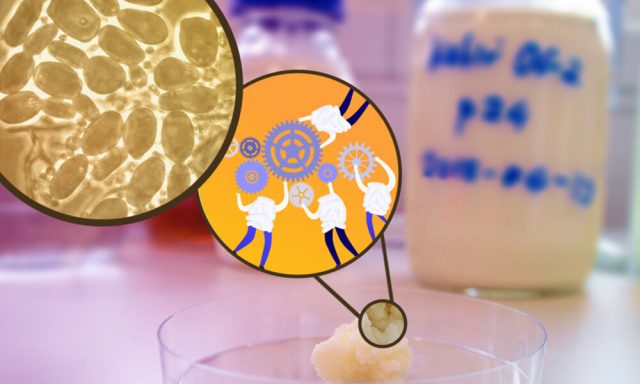
To make kefir, it takes a team. A team of microbes.
That's the message of new research from EMBL and Cambridge University's Patil group and collaborators, published in Nature Microbiology today. Members of the group study kefir, one of the world's oldest...

If you type into a search engine—"why do men have to wait before having sex again?"—the results will include many references to prolactin. This hormone is thought to be involved in hundreds of physiological processes in the body. Among...

In a joint collaboration, Danish and German researchers have characterized a cellular activity that protects our cells from potentially toxic by-products of gene expression. This activity is central for the ability of multicellular organisms to uphold a robust evolutionary...

Thanks to the marine worm Platynereis dumerilii, an animal whose genes have evolved very slowly, scientists from CNRS, Université de Paris and Sorbonne Université, in association with others at the University of Saint Petersburg and the University of Rio...

Biochemists have developed a new strategy for controlling the biological functions of DNA (deoxyribonucleic acid) by means of light and therefore provide a tool to investigate processes which take place in cells.
DNA (deoxyribonucleic acid) is the basis of life...

Cells, the basic unit of life, are surrounded by a limiting membrane called the plasma membrane. Inside cells, there are various membrane-bounded organelles, each of which has various and distinctive functions. How these organelles, which individually boast different functions,...


