




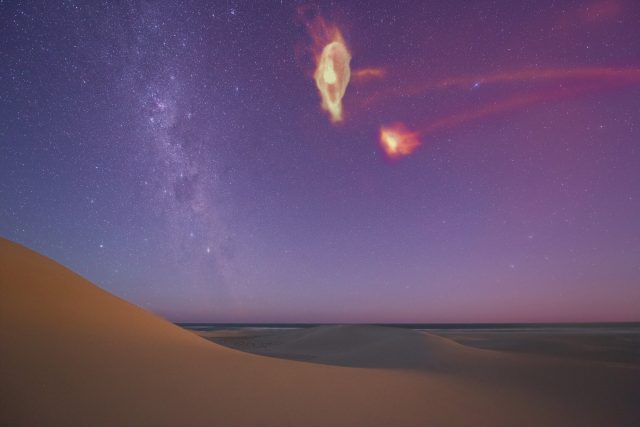
The Milky Way is not alone in its neighborhood. It has captured smaller galaxies in its orbit, and the two largest are known as the Small and Large Magellanic Clouds, visible as twin dusty smears in the Southern Hemisphere.
As...

A radio telescope in outback Western Australia has completed the deepest and broadest search at low frequencies for alien technologies, scanning a patch of sky known to include at least 10 million stars.
Astronomers used the Murchison Widefield Array (MWA) telescope to...

Massive stars are those larger than about 10 times the mass of the sun and are born far less often than their low-mass counterparts. However, they contribute the most to the evolution of star clusters and galaxies. Massive stars...

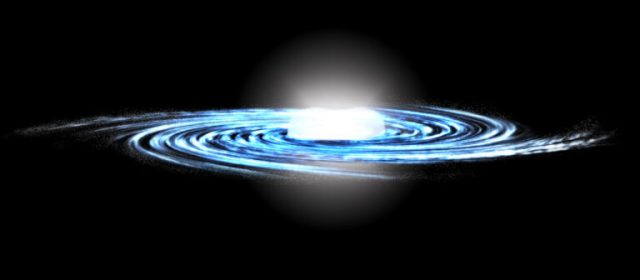
Black holes can expel a thousand times more matter than they capture. The mechanism that governs both ejection and capture is the accretion disk, a vast mass of gas and dust spiraling around the black hole at extremely high...

An analytical breakthrough that could significantly improve our chances of finding extra-terrestrial life in our galaxy has been discovered by a team at The University of Manchester.
In new research published today in Monthly Notices of the Royal Astronomical Society, the...

For all its vast emptiness, the universe is humming with activity in the form of gravitational waves. Produced by extreme astrophysical phenomena, these reverberations ripple forth and shake the fabric of space-time, like the clang of a cosmic bell.h
Now...

Astronomers have known for two decades that the expansion of the universe is accelerating, but the physics of this expansion remains a mystery. Now, a team of researchers at the University of Hawai'i at Mānoa have made a novel...
The detection more than a decade ago by the Fermi Gamma Ray Space Telescope of an excess of high-energy radiation in the center of the Milky Way convinced some physicists that they were seeing evidence of the annihilation of...

Astronomers have used the GRAVITY instrument to study the immediate vicinity of a young star in more detail than ever before. Their observations confirm a thirty-year-old theory about the growth of young stars: the magnetic field produced by the...
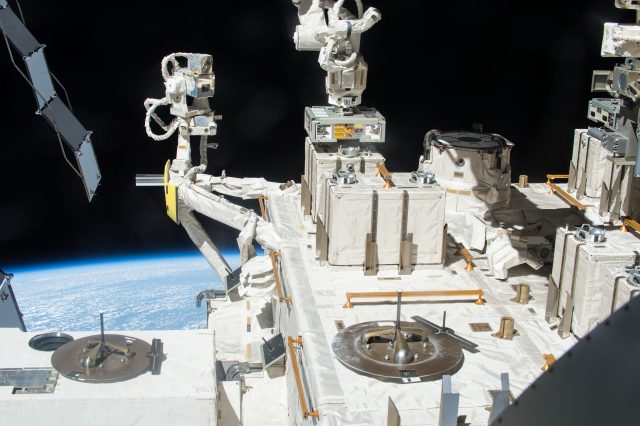
Imagine microscopic life-forms, such as bacteria, transported through space, and landing on another planet. The bacteria finding suitable conditions for its survival could then start multiplying again, sparking life at the other side of the universe. This theory, called...
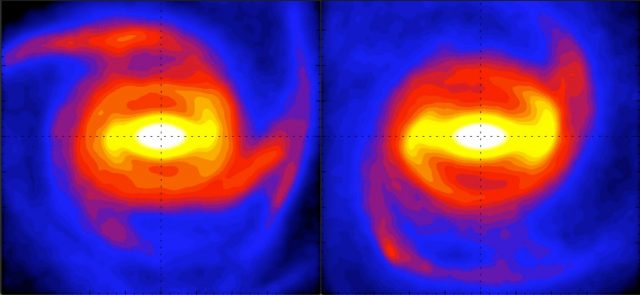
New light has been shed on a mysterious and long-standing conundrum at the very heart of our galaxy. The new work offers a potential solution to the so-called "Galactic bar paradox," whereby different observations produce contradictory estimates of the...


