





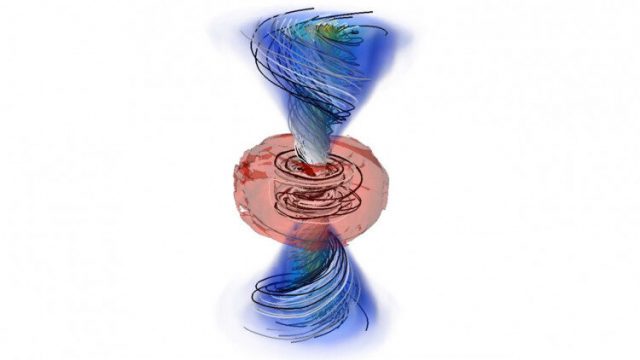
An international team of astrophysicists under Dutch leadership has demonstrated with an improved model that colliding neutron stars can emit gamma rays. Old models did not predict this and faltered since the merging of two neutron stars in 2017...
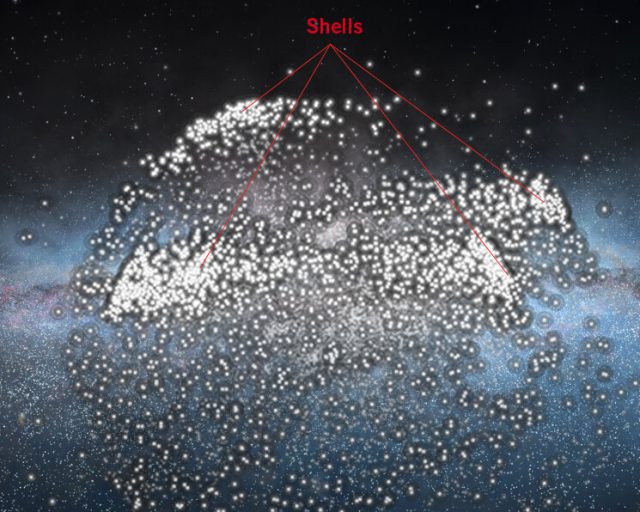
Nearly 3 billion years ago, a dwarf galaxy plunged into the center of the Milky Way and was ripped apart by the gravitational forces of the collision. Astrophysicists announced today that the merger produced a series of telltale shell-like...

Red dwarfs are the coolest kind of star. As such, they potentially allow liquid water to exist on planets that are quite close to them. In the search for habitable worlds beyond the borders of our solar system, this...

Particles smaller than an atom hurtle through the universe nearly at the speed of light, blasted into space from something, somewhere, in the cosmos.
A scientific collaboration of the Pierre Auger Observatory, including researchers from the University of Delaware, has...
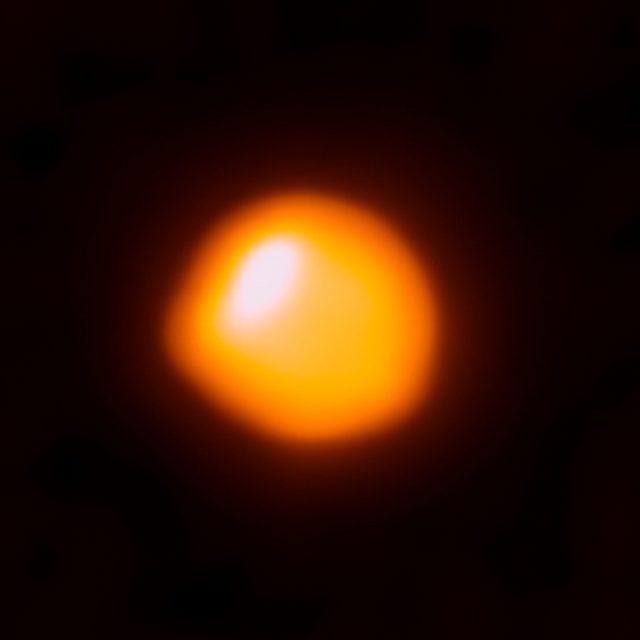
It may be another 100,000 years until the giant red star Betelgeuse dies in a fiery explosion, according to a new study by an international team of researchers.
The study, led by Dr. Meridith Joyce from The Australian National University...
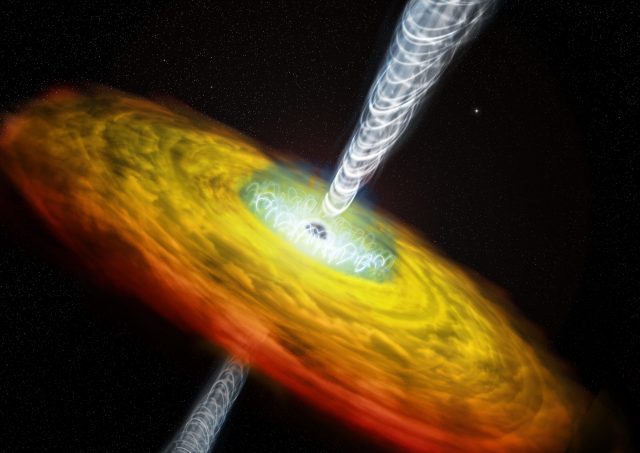
Some supermassive black holes launch powerful beams of material, or jets, while others do not. Astronomers may now have identified why.
Using data from NASA's Chandra X-ray Observatory, ESA's XMM-Newton, Germany's ROentgen SATellite (ROSAT), the NSF's Karl G. Jansky Very...
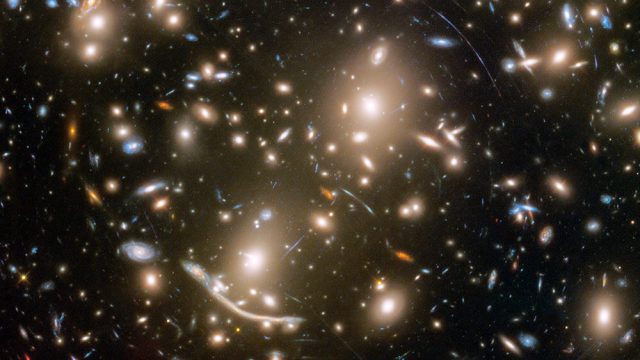
Light from distant galaxies reveals important information about the nature of the universe and allows scientists to develop high-precision models of the history, evolution and structure of the cosmos.
The gravity associated with massive pockets of dark matter that lie...
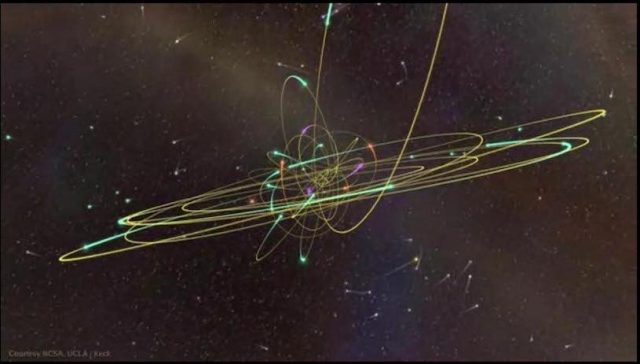
Once a black hole forms, its intense gravitational field produces a surface beyond which even light cannot escape, and it appears black to outsiders. All the details of the complex mix of matter and energy in its past are...

In 2015, the New Horizons space probe discovered spectacular snowcapped mountains on Pluto, which are strikingly similar to mountains on Earth. Such a landscape had never before been observed elsewhere in the Solar System. However, as atmospheric temperatures on...

At present, the formation of galaxies is difficult to understand without the presence of a ubiquitous, but mysterious component, termed dark matter. Astronomers have measure how much dark matter there is around galaxies, and have found that it varies...
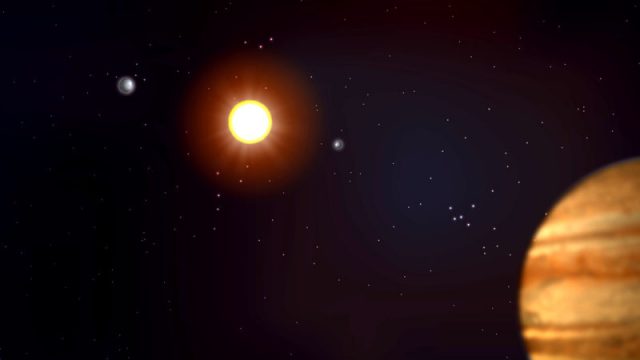
An international group of astronomers, led by Martin Schlecker of the Max Planck Institute for Astronomy, has found that the arrangement of rocky, gaseous and icy planets in planetary systems is apparently not random and depends on only a...


