




Massive galaxies were already much more mature in the early universe than previously expected. This was shown by an international team of astronomers who studied 118 distant galaxies with the Atacama Large Millimeter/submillimeter Array (ALMA).
Most galaxies formed when the...

Humankind's next giant step may be onto Mars. But before those missions can begin, scientists need to make scores of breakthrough advances, including learning how to grow crops on the red planet.
Practically speaking, astronauts cannot haul an endless supply...
For much of Earth's four and a half billion years, the planet was barren and inhospitable; it wasn't until the world acquired its blanket of oxygen that multicellular life could really get going. But scientists are still trying to...

A new study authored by Southwest Research Insti-tute planetary scientist Dr. Tracy Becker discusses several new views of the asteroid 16 Psyche, including the first ultraviolet observations. The study, which was published today in The Planetary Science Journal and presented at...

A relatively new method to control nuclear fusion that combines a massive jolt of electricity with strong magnetic fields and a powerful laser beam has achieved its own record output of neutrons—a key standard by which fusion efforts are...

New results from NASA's Juno mission at Jupiter suggest that either "sprites" or "elves" could be dancing in the upper atmosphere of the solar system's largest planet. It is the first time these bright, unpredictable and extremely brief flashes...
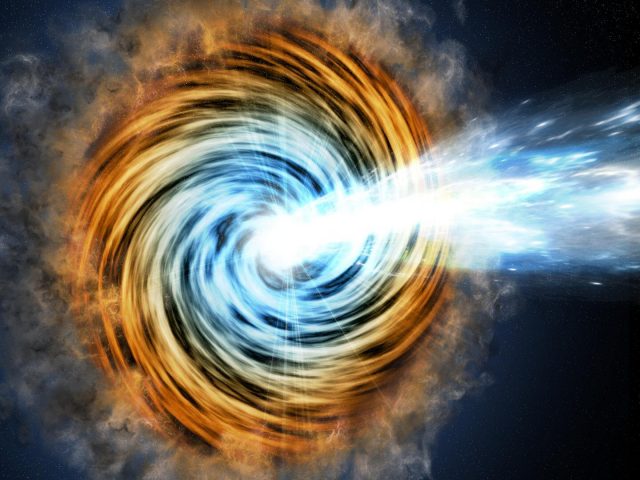
An international team of astronomers has identified one of the rarest known classes of gamma-ray emitting galaxies, called BL Lacertae, within the first 2 billion years of the age of the Universe. The team, that has used one of...

TESS, the Transiting Exoplanet Survey Satellite, was launched in 2018 with the goal of discovering small planets around the Sun's nearest neighbors, stars bright enough to allow for follow-up characterizations of their planets' masses and atmospheres. TESS has so...
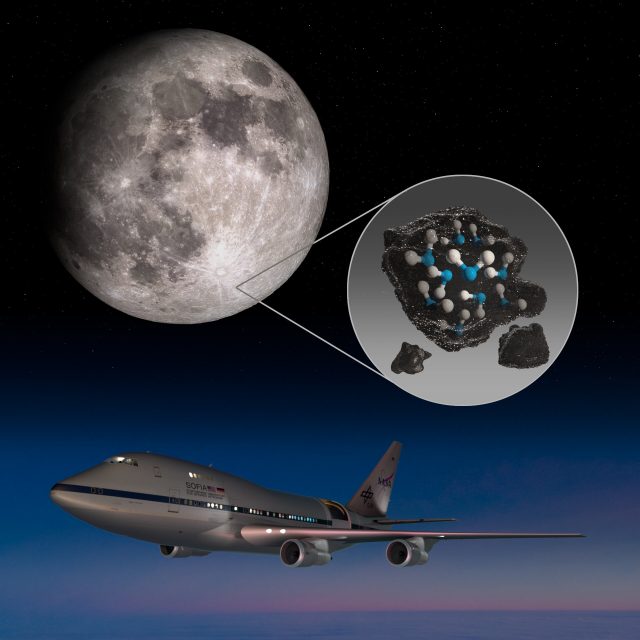
NASA's Stratospheric Observatory for Infrared Astronomy (SOFIA) has confirmed, for the first time, water on the sunlit surface of the Moon. This discovery indicates that water may be distributed across the lunar surface, and not limited to cold, shadowed...

A team led by an astronomer from the University of Kansas has crunched data from NASA's TESS and Spitzer space telescopes to portray for the first time the atmosphere of a highly unusual kind of exoplanet dubbed a "hot...

Three decades after Cornell astronomer Carl Sagan suggested that Voyager 1 snap Earth's picture from billions of miles away—resulting in the iconic Pale Blue Dot photograph—two astronomers now offer another unique cosmic perspective:https://9d5f7c42d837a144cd86cb3c25f905e1.safeframe.googlesyndication.com/safeframe/1-0-37/html/container.html
Some exoplanets—planets from beyond our own solar...


