



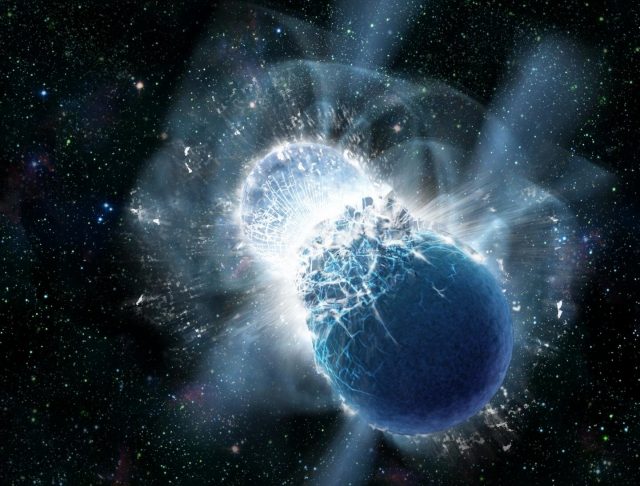
A new study lead by GSI scientists and international colleagues investigates black-hole formation in neutron star mergers. Computer simulations show that the properties of dense nuclear matter play a crucial role, which directly links the astrophysical merger event to...

On Jupiter's icy moon Europa, powerful eruptions may spew into space, raising questions among hopeful astrobiologists on Earth: What would blast out from miles-high plumes? Could they contain signs of extraterrestrial life? And where in Europa would they originate?...
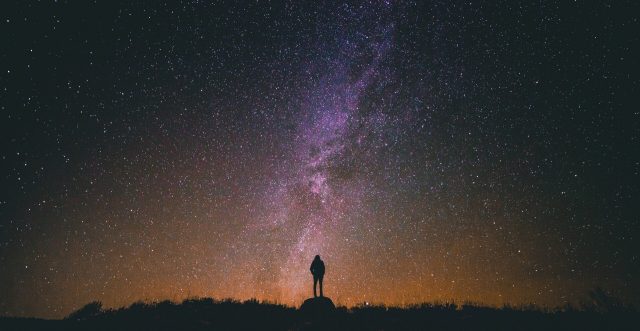
The universe is getting hotter, a new study has found.
The study, published Oct. 13 in the Astrophysical Journal, probed the thermal history of the universe over the last 10 billion years. It found that the mean temperature of gas across the...

The first mining experiments conducted in space could pave the way for new technologies to help humans explore and establish settlements on distant worlds, a study suggests.
Tests performed by astronauts on the International Space Station suggest that bacteria can...

The amount of long-lived radioactive elements incorporated into a rocky planet as it forms may be a crucial factor in determining its future habitability, according to a new study by an interdisciplinary team of scientists at UC Santa Cruz.
That's...

Solving the equations of general relativity for colliding black holes is no simple matter.
Physicists began using supercomputers to obtain solutions to this famously hard problem back in the 1960s. In 2000, with no solutions in sight, Kip Thorne, 2018...

Fast radio bursts, or FRBs -- powerful, millisecond-duration radio waves coming from deep space outside the Milky Way Galaxy -- have been among the most mysterious astronomical phenomena ever observed. Since FRBs were first discovered in 2007, astronomers from...

The luminous, barred galaxy ESO 320-G030 is about one hundred and fifty million light-years away and shows no signs of having been in a merger, yet this galaxy has a bar nearly sixty thousand light-years long, as well as...
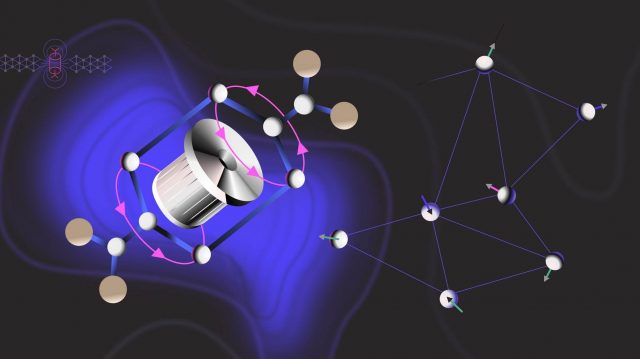
In 1973, physicist and later Nobel laureate Philip W. Anderson proposed a bizarre state of matter: the quantum spin liquid (QSL). Unlike the everyday liquids we know, the QSL actually has to do with magnetism -- and magnetism has...

A small team of astronomers have found a new way to 'see' the elusive dark matter haloes that surround galaxies, with a new technique 10 times more precise than the previous-best method. The work is published in Monthly Notices of...

New data from a Canadian-led team of astronomers, including researchers from the McGill Space Institute and McGill University Department of Physics, strongly suggest that magnetars -- a type of neutron star believed to have an extremely powerful magnetic field...


