



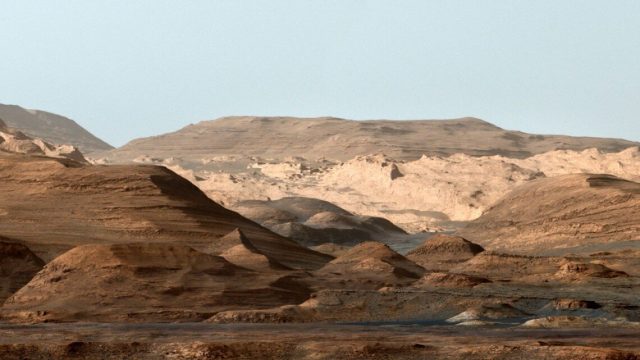
Floods of unimaginable magnitude once washed through Gale Crater on Mars' equator around 4 billion years ago -- a finding that hints at the possibility that life may have existed there, according to data collected by NASA's Curiosity rover...

Astronomers using data from the ongoing VLA Sky Survey (VLASS) have found a number of distant galaxies with supermassive black holes at their cores that have launched powerful, radio-emitting jets of material within the past two decades or so....

Scientists have discovered a rare object called the Blue Ring Nebula, a ring of hydrogen gas with a star at its center. The properties of this system suggest it is the remnant of two stars meeting their ultimate demise:...
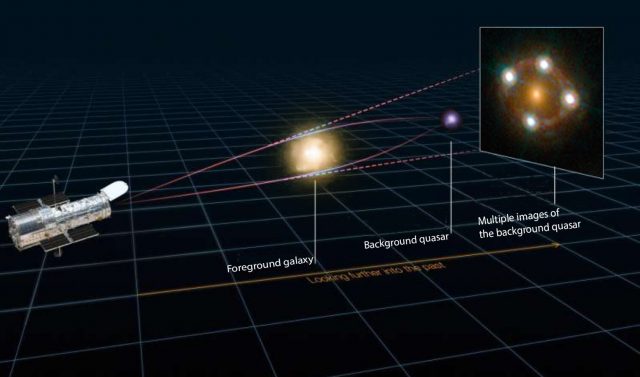
The universe is expanding but astrophysicists aren't sure exactly how fast that expansion is happening—not because there aren't answers, but rather because the answers they could give don't agree.
Now, Simon Birrer, a postdoctoral fellow at Stanford University and the...

An astrophysicist at the University of Bologna and a neurosurgeon at the University of Verona compared the network of neuronal cells in the human brain with the cosmic network of galaxies... and surprising similarities emerged
In their paper published in Frontiers...

A group of astronomers from The University of Texas at Austin has found that a telescope idea shelved by NASA a decade ago can solve a problem that no other telescope can: It would be able to study the...

An international team of scientists have shown that glycine, the simplest amino acid and an important building block of life, can form under the harsh conditions that govern chemistry in space.
The results, published in Nature Astronomy, suggest that glycine, and...

Theories on how the Milky Way formed are set to be rewritten following discoveries about the behavior of some of its oldest stars
An investigation into the orbits of the Galaxy's metal-poor stars—assumed to be among the most ancient in...

Plumes of water vapor that may be venting into space from Jupiter's moon Europa could come from within the icy crust itself, according to new research. A model outlines a process for brine, or salt-enriched water, moving around within...

A long time ago—roughly 4.5 billion years—our sun and solar system formed over the short time span of 200,000 years. That is the conclusion of a group of Lawrence Livermore National Laboratory (LLNL) scientists after looking at isotopes of...
rth's climate over the last 40,000 years.
The results are far from conclusive, but they offer tantalizing hints that, when it comes to the stability of life on Earth, what happens in space doesn't always stay in space.
"These are extreme...


