




An international study led from the University of Turku discovered phosphorus and fluorine in solid dust particles collected from a comet. The finding indicates that all the most important elements necessary for life may have been delivered to the...

Researchers at the Niels Bohr Institute, University of Copenhagen, have investigated more than 1000 planetary systems orbiting stars in our own galaxy, the Milky Way, and have discovered a series of connections between planetary orbits, number of planets, occurrence...
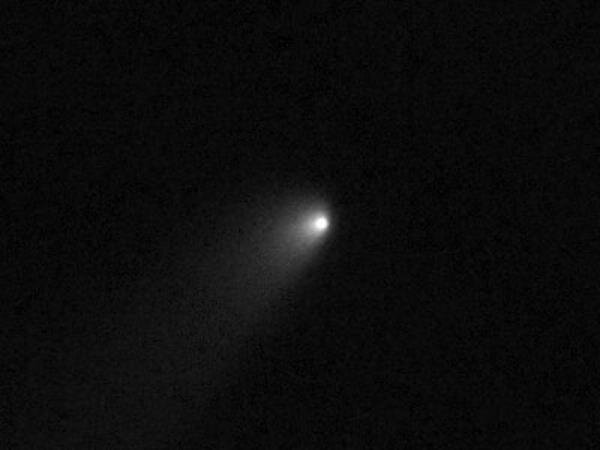
A comet discovered last year is offering scientists new insights into how these objects "turn on" and evolve, as it actually transitions out of the Centaur population and into the Jupiter Family of Comets (JFCs), according to a paper...
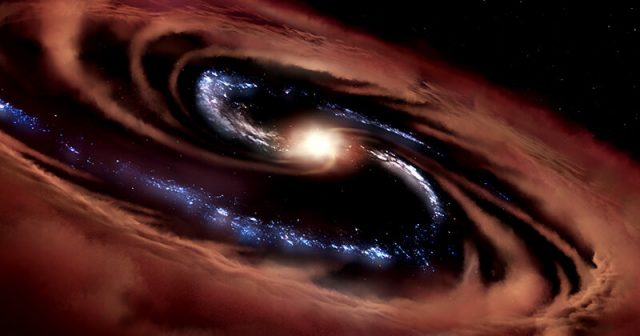
Black holes are thought to gobble up so much surrounding material that they put an end to the life of their host galaxy. In that process they create a highly energetic object called a quasar which was previously thought...

Earth just got 7 km/s faster and about 2000 light-years closer to the supermassive black hole in the center of the Milky Way Galaxy. But don't worry, this doesn't mean that our planet is plunging towards the black hole....

A faraway galaxy with almost no dark matter has threatened to break our theory of galaxy formation. New evidence suggests the galaxy isn't an anomaly—but a victim of theft.
Dark matter—an invisible substance as enigmatic as its name suggests—is a...
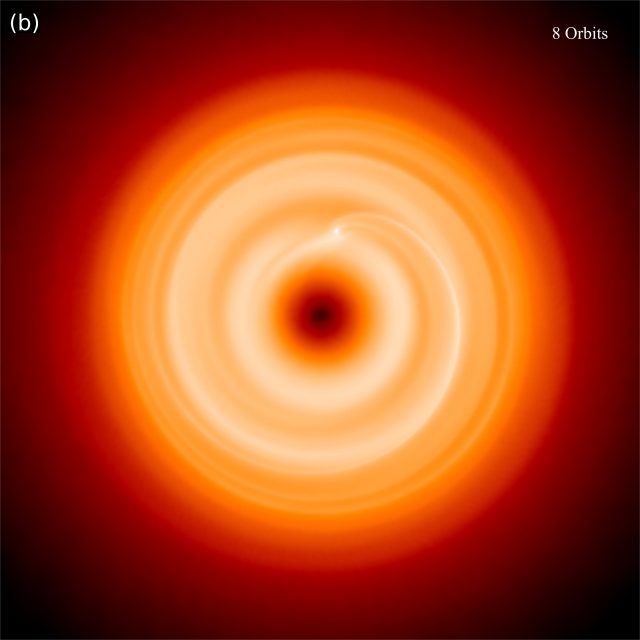
The research, published today in the Astrophysical Journal Letters andpart supported by the Royal Society, provides an explanation for the lack of spiral structure that astronomers expect to see in protoplanetary discs around young stars that also suggests that scientists may have to reassess how...

In 2018 an international team of researchers using the NASA/ESA Hubble Space Telescope and several other observatories uncovered, for the first time, a galaxy in our cosmic neighbourhood that is missing most of its dark matter. This discovery of the...

The spiral-shaped disc of stars and planets is being pulled, twisted and deformed with extreme violence by the gravitational force of a smaller galaxy -- the Large Magellanic Cloud (LMC).
Scientists believe the LMC crossed the Milky Way's boundary around...
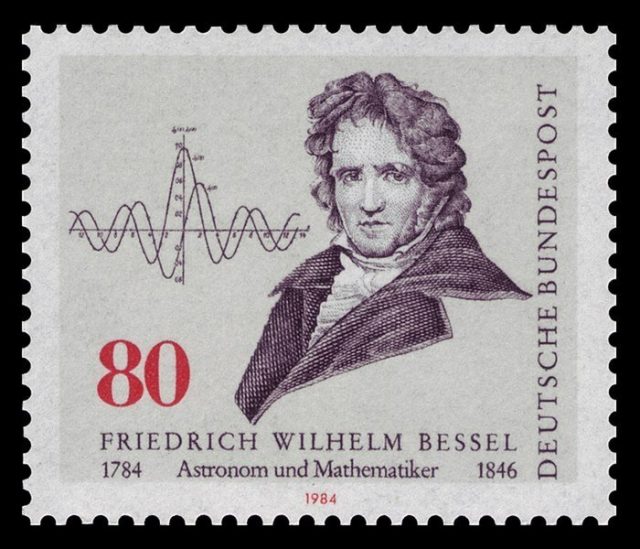
In 1838, Friedrich Wilhelm Bessel won the race to measure the first distance to a star other than our Sun via the trigonometric parallax—setting the first scale of the universe.
Recently, Mark Reid and Karl Menten, who are engaged in...

Scientists working with data from the Sloan Digital Sky Surveys' Apache Point Observatory Galactic Evolution Experiment (APOGEE) have discovered a "fossil galaxy" hidden in the depths of our own Milky Way.
This result, published today in Monthly Notices of the Royal...


