




A planet in an unlikely orbit around a double star 336 light-years away may offer a clue to a mystery much closer to home: A hypothesized, distant body in our solar system dubbed "Planet Nine."
This is the first time...

A discovery that links stellar flares with radio-burst signatures will make it easier for astronomers to detect space weather around nearby stars outside the Solar System. Unfortunately, the first weather reports from our nearest neighbor, Proxima Centauri, are not...

In direct contradiction to the official forecast, a team of scientists led by the National Center for Atmospheric Research (NCAR) is predicting that the Sunspot Cycle that started this fall could be one of the strongest since record-keeping began.
In...

Images from the Survey of the MAgellanic Stellar History (SMASH) reveal a striking family portrait of our galactic neighbors—the Large and Small Magellanic Clouds. The images represent a portion of the second data release from the deepest, most extensive...

Astronomers have taken a step towards understanding how the Moon might have formed out of a giant collision between the early Earth and another massive object 4.5 billion years ago.
Scientists led by Durham University, UK, ran supercomputer simulations on the DiRAC...

In a new paper published in the journal Nature Communications Earth and Environment, researchers at the University of Rochester were able to use magnetism to determine, for the first time, when carbonaceous chondrite asteroids -- asteroids that are rich in water...
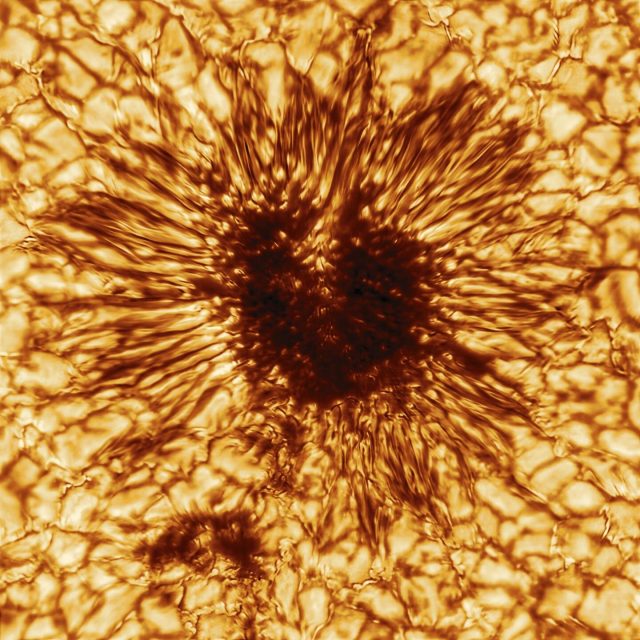
The world's largest solar observatory, the U.S. National Science Foundation's Daniel K. Inouye Solar Telescope, just released its first image of a sunspot. Although the telescope is still in the final phases of completion, the image is an indication...

More than 40 years since they launched, the Voyager spacecraft are still making discoveries.
In a new study, a team of physicists led by the University of Iowa report the first detection of bursts of cosmic ray electrons accelerated by...

The Australian Square Kilometre Array Pathfinder (ASKAP), developed and operated by Australia's national science agency, CSIRO, mapped approximately three million galaxies in just 300 hours.
The Rapid ASKAP Continuum Survey is like a Google map of the universe where most...

The new data include exceptionally accurate measurements of the 300,000 stars within the closest 326 light years to the Sun. The researchers use these data to predict how the star background will change in the next 1.6 million years. They also...
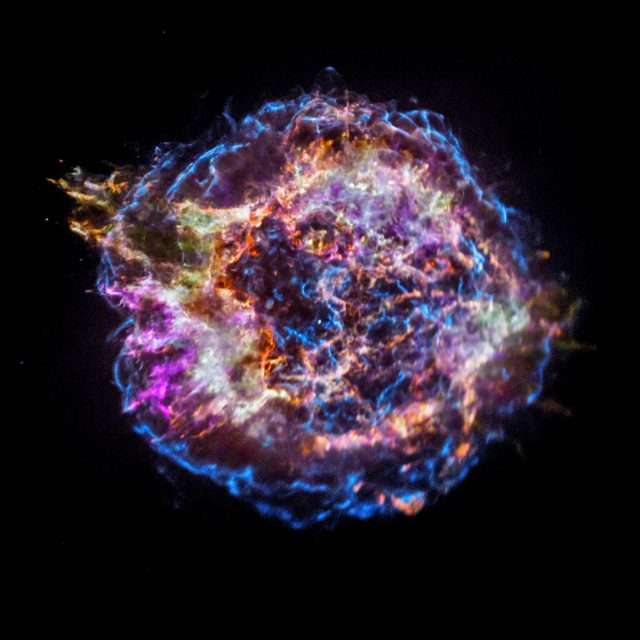
Michigan State University (MSU) researchers have discovered that one of the most important reactions in the universe can get a huge and unexpected boost inside exploding stars known as supernovae.
This finding also challenges ideas behind how some of the...


