


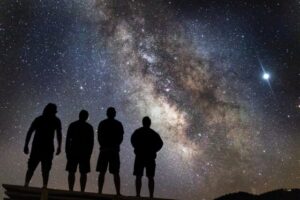
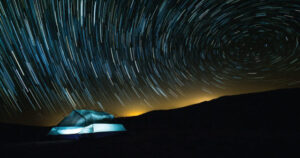


Just as archaeologists dig hoping to find traces of the past, an international group of astrophysicists managed to get into the thick cloud of dust around the center of the Milky Way (also known as the bulge) discovering primordial...
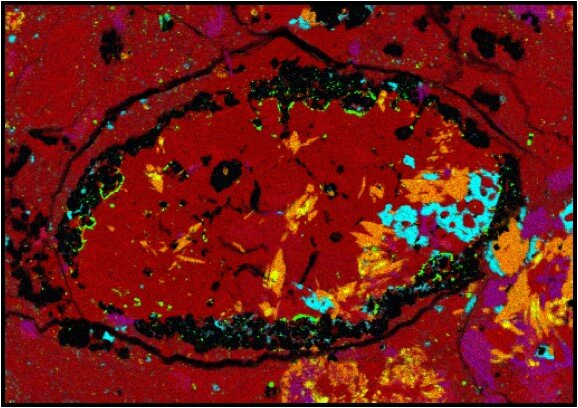
A Southwest Research Institute-led team of scientists has identified a potentially new meteorite parent asteroid by studying a small shard of a meteorite that arrived on Earth a dozen years ago. The composition of a piece of the meteorite...

More than half of the matter in our universe has so far remained hidden from us. However, astrophysicists had a hunch where it might be: In so-called filaments, unfathomably large thread-like structures of hot gas that surround and connect...

Astronomers using NASA's Hubble Space Telescope watched a mysterious dark vortex on Neptune abruptly steer away from a likely death on the giant blue planet.
The storm, which is wider than the Atlantic Ocean, was born in the planet's northern...

An international group of scientists, including Case Western Reserve University Astronomy Chair Stacy McGaugh, has published research contending that a rival idea to the popular dark matter hypothesis more accurately predicts a galactic phenomenon that appears to defy the...

By monitoring the cosmos with a radio telescope array, a Cornell University-led international team of scientists has detected radio bursts emanating from the constellation Boötes. The signal could be the first radio emission collected from a planet beyond our...

Astronomers using two Maunakea Observatories—Subaru Telescope and W. M. Keck Observatory—have discovered a key benchmark brown dwarf orbiting a sun-like star just 86 light-years from Earth that provides a key reference point for understanding the properties of the first...

Researchers have discovered a new superhighway network to travel through the Solar System much faster than was previously possible. Such routes can drive comets and asteroids near Jupiter to Neptune's distance in under a decade and to 100 astronomical...

So young and already so evolved: Thanks to observations obtained at the Large Binocular Telescope, an international team of researchers coordinated by Paolo Saracco of the Istituto Nazionale di Astrofisica (INAF, Italy) was able to reconstruct the wild evolutionary...

A study by the University of Southampton gives a new perspective on why our planet has managed to stay habitable for billions of years -- concluding it is almost certainly due, at least in part, to luck. The research...

In the moments immediately following the Big Bang, the very first gravitational waves rang out. The product of quantum fluctuations in the new soup of primordial matter, these earliest ripples through the fabric of space-time were quickly amplified by...


