



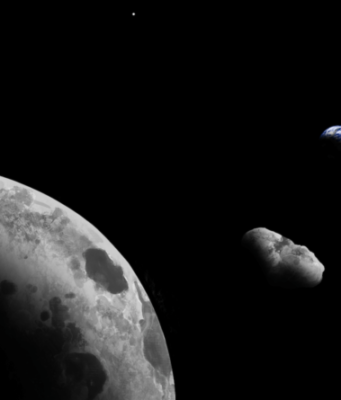

Artist’s conception.Credit: courtesy of Robin Dienel
When a star is young, it is often still surrounded by a primordial rotating disk of gas and dust, from which planets can form. Astronomers like to find such disks because they might be...

The merger of two black holes, where one is so large that only a portion of it --nearly flat-- is shown, while the other, smaller black hole falls into and is absorbed by the larger one.Credit: Roberto Emparan &...

Pluto's famous "heart," half of which was created by an ancient impact, offers clues about a possible subsurface ocean. Credit: NASA/APL/SwRI
A giant asteroid impact in the dwarf planet’s past offers new insights into the possibility of an ocean beneath...

International teams of astronomers have used the Atacama Large Millimeter/submillimeter Array (ALMA) to explore the distant corner of the Universe first revealed in the iconic images of the Hubble Ultra Deep Field (HUDF). These new ALMA observations are significantly...

Illustration of the possible patterns an anisotropic universe would leave in the cosmic microwave background, including (clockwise from bottom left) the contribution from quantum fluctuations, and from three different aspects of the anisotropic expansion.Credit: Saadeh et al.
The universe is...

This artist's illustration shows a gas giant planet circling a pair of red dwarf stars. The Saturn-mass planet orbits roughly 300 million miles from the stellar duo. The two red dwarf stars are a mere 7 million miles apart.Credit:...

Planetary disk around the star known as TW Hydrae. Credit: S. Andrews (Harvard-Smithsonian CfA); B. Saxton (NRAO/AUI/NSF); ALMA (ESO/NAOJ/NRAO)
The dusty disk surrounding the star TW Hydrae exhibits circular features that may signal the formation of protoplanets. LMU astrophysicist Barbara...

This rendering shows a snapshot from a cosmological simulation of a Lyman-alpha Blob similar to LAB-1. This simulation tracks the evolution of gas and dark matter using one of the latest models for galaxy formation running on the NASA...

The hazy globe of Titan hangs in front of Saturn and its rings in this natural color view from NASA's Cassini spacecraft. Credit: NASA/JPL-Caltech/Space Science Institute
The puzzling appearance of an ice cloud seemingly out of thin air has prompted...

These pseudotachylites -- fine grained rocks -- are from the British Isles.Credit: Image courtesy of Yale University
A new study shows that rocks formed by the grinding together of other rocks during earthquakes are rich in trapped hydrogen -- a...

The polar cap of "Sputnik Planum," in false colors, is surrounded by mountains which have been eroded and shaped by the glacial activity. The dark areas are covered by organic materials produced by the photolysis of methane by solar...


