




The data used in this image were taken with Hubble’s Advanced Camera for Surveys in September 2015.Credits: NASA, ESA, STScI, K. Sandstrom (University of California, San Diego), and the SMIDGE team
NASA’s Hubble Space Telescope captured two festive-looking nebulas, situated...

Credit: X-ray: NASA/CXC/PSU/L.Townsley et al; Optical: UKIRT; Infrared: NASA/JPL-Caltech
Although there are no seasons in space, this cosmic vista invokes thoughts of a frosty winter landscape. It is, in fact, a region called NGC 6357 where radiation from hot, young...

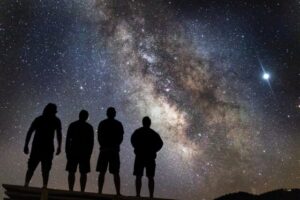
The Atacama Large Millimeter/submillimeter Array (ALMA), as captured in phenomenal panorama from 5,000 meters at Chilean Altiplano -- the highlands of the Andes Mountains. The Milky Way was passing through its zenith at that very moment, and Zodiacal light...

This compressed view of the entire sky visible from Hawai'i by the Pan-STARRS1 Observatory is the result of half a million exposures, each about 45 seconds in length, taken over a period of four years.The shape comes from making...

The data that were analysed in the work described here. Fluctuations in the isotropic gamma-ray background, based on 81 months of data. Emission from our own Galaxy, the Milky Way, is masked in grey. Credit: Mattia Fornasa, UvA/Grappa
Researchers from...

Dan Tamayo is a postdoctoral fellow in the Centre for Planetary Science at U of T Scarborough.Credit: Photo by Ken Jones
Same class of algorithms used by Google and Netflix can also tell us if distant planetary systems are stable...

IC 5201 sits over 40 million light-years away from us. As with two thirds of all the spirals we see in the universe -- including the Milky Way, the galaxy has a bar of stars slicing through its center....

View of the North Pole: The colours show the varying height of Ceres' landscape. The numbers refer to ten craters where the Framing Cameras built in Göttingen at the Max Planck Institute for Solar System Research have discovered water...

The gravity of galaxies bends space, such that the light traveling through this space is bent. This bending of light allows astronomers to measure the distribution of gravity around galaxies, even up to distances a hundred times larger than...

Neptune-mass exoplanets like the one shown in this artist's rendering may be the most common in the icy regions of planetary systems. Beyond a certain distance from a young star, water and other substances remain frozen, leading to an...

This computer-simulated image shows a supermassive black hole at the core of a galaxy. The black region in the center represents the black hole's event horizon, where no light can escape the massive object's gravitational grip. The black hole's...


