



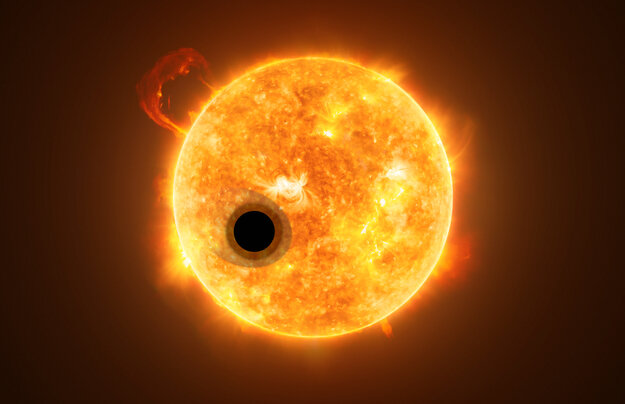
The core mass of the giant exoplanet WASP-107b is much lower than what was thought necessary to build up the immense gas envelope surrounding giant planets like Jupiter and Saturn, astronomers at Université de Montréal have found.
This intriguing discovery...

Galaxies begin to "die" when they stop forming stars, but until now astronomers had never clearly glimpsed the start of this process in a far-away galaxy. Using the Atacama Large Millimeter/submillimeter Array (ALMA), in which the European Southern Observatory...

A new study, led by a theoretical physicist at the U.S. Department of Energy's Lawrence Berkeley National Laboratory (Berkeley Lab), suggests that never-before-observed particles called axions may be the source of unexplained, high-energy X-ray emissions surrounding a group of...

In a case of comic mistaken identity, an international team of astronomers revealed that what they once thought was a supernova is actually periodic flaring from a galaxy where a supermassive black hole gives off bursts of energy every...

During a typical year, over a million people visit Yellowstone National Park, where the Old Faithful geyser regularly blasts a jet of boiling water high in the air. Now, an international team of astronomers has discovered a cosmic equivalent,...

How dark is the sky, and what does that tell us about the number of galaxies in the visible universe? Astronomers can estimate the total number of galaxies by counting everything visible in a Hubble deep field and then...
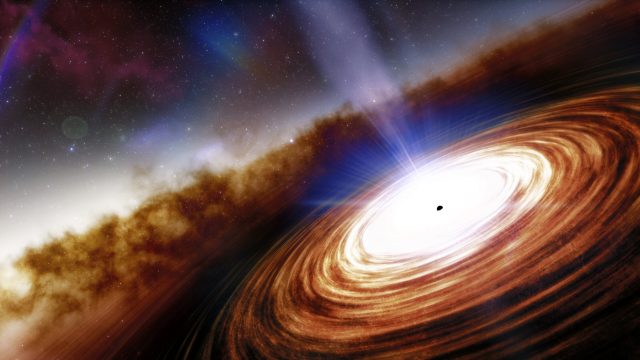
A team of astronomers led by the University of Arizona has observed a luminous quasar 13.03 billion light-years from Earth—the most distant quasar discovered to date. Dating back to 670 million years after the Big Bang, when the universe...

It is well known that the expansion of the universe is accelerating due to a mysterious dark energy. Within galaxies, stars also experience an acceleration, though this is due to some combination of dark matter and the stellar density....

Early astronomers painstakingly studied the subtle movements of stars in the night sky to try and determine how our planet moves in relation to other celestial bodies. As technology has increased, so has the understanding of how the universe...
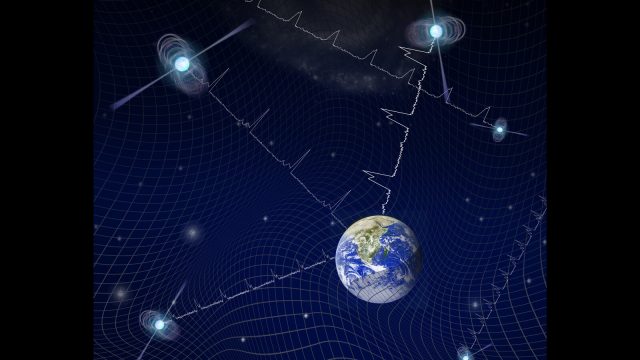
't say yet that this is the gravitational wave background."
In 2017, scientists on an experiment called the Laser Interferometer Gravitational-Wave Observatory (LIGO) won the Nobel Prize in Physics for the first-ever direct detection of gravitational waves. Those waves were...
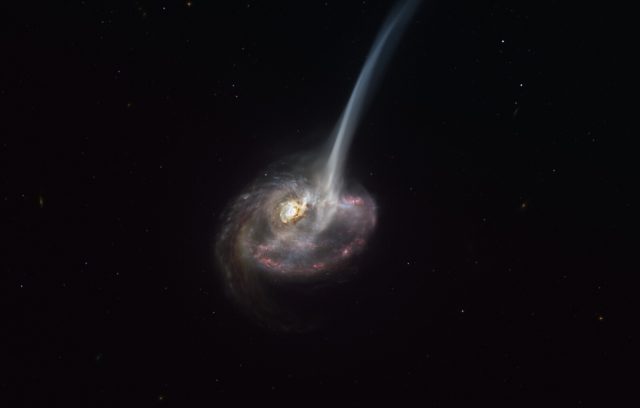
Astronomers have looked nine billion years into the past to find evidence that galaxy mergers in the early universe could shut down star formation and affect galaxy growth.
New research led by Durham University, UK, the French Alternative Energies and...


