




While the Arecibo radio telescope could only localize the fast radio burst to the area inside the two circles, the VLA was able to pinpoint it as a dwarf galaxy within the square, shown at the intersection of the...

Image Credit: ISRO
Indian Space Research Organisation (ISRO) will launch a record 103 satellites — all but three of them foreign — at one go on a single rocket in the first week of February in what will be a...

The left panel shows a false-color image of PGC 1000714. The right panel shows a B-I color index map that reveals both the outer ring (blue) and diffuse inner ring (light green). Credit: Ryan Beauchemin
Approximately 359 million light-years away...

This image from the VISTA infrared survey telescope at ESO's Paranal Observatory in northern Chile is part of the largest infrared high-resolution mosaic of Orion ever created. It covers the Orion A molecular cloud, the nearest known massive star...

This cut-away view shows radar return power (blue high, red low) from features within Planum Boreum, the Martian north polar cap. The depth-converted 3-D volume of SHARAD data encompasses all of Planum Boreum. For scale, the no-data zone is...

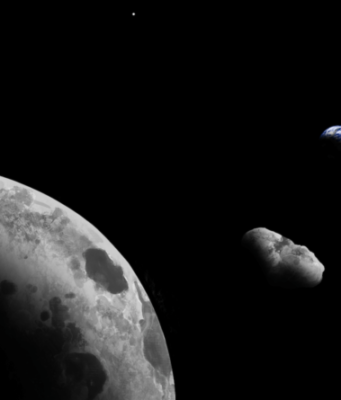
An artist’s rendition of 2016 WF9 as it passes Jupiter’s orbit inbound toward the sun.Credits: NASA/JPL-Caltech
NASA's NEOWISE mission has recently discovered some celestial objects traveling through our neighborhood, including one on the blurry line between asteroid and comet. Another--definitely...

This megamaser galaxy is named IRAS 16399-0937 and is located over 370 million light-years from Earth. This NASA/ESA Hubble Space Telescope image belies the galaxy's energetic nature, instead painting it as a beautiful and serene cosmic rosebud. The image...

The discrepancy between the cosmological parameters in the modern Universe and the Universe shortly after the Big Bang can be explained by the fact that the proportion of dark matter has decreased. The authors of the study could calculate...

An image of the moon was taken with an 8-inch refracting telescope during one of the astrophotography classes. The image is a mosaic of two images, which were reduced and processed to increase the detail and contrast. Credit: UC...

The white/blue image is the Milky Way, with the central bulge on the left and the plane of the disk running horizontally across the region; the yellow/green dots are the distribution of galaxies in the nearby universe; the Vela...

The compound view shows a new ALMA Band 5 view of the colliding galaxy system Arp 220 (in red) on top of an image from the NASA/ESA Hubble Space Telescope (blue/green). With the newly installed Band 5 receivers, ALMA...


