




Image of the HST GOODS-South field, one of the deepest images of the sky but covering just one millionth of its total area. The new estimate for the number of galaxies is ten times higher than the number seen...

This is astronaut Alan B. Shepard Jr. on the moon in 1971 with the Apollo 14 mission.Credit: NASA
Formation occurred 4.51 billion years ago, millions of years earlier than previously believed
A UCLA-led research team reports that the moon is at...

This image shows the closest stellar system to the Sun, the bright double star Alpha Centauri AB and its distant and faint companion Proxima Centauri. In late 2016 ESO signed an agreement with the Breakthrough Initiatives to adapt the...

In this computer-generated image, a red oval marks the disk of our Milky Way galaxy and a red dot shows the location of the Sagittarius dwarf galaxy. The yellow circles represent stars that have been ripped from the Sagittarius...

This artist's impression shows a Milky Way type galaxy in the local Universe, surrounded by a much larger halo of blue, faint light, made of Lyman-alpha photons. While these photons were produced around hot, young stars in much more...

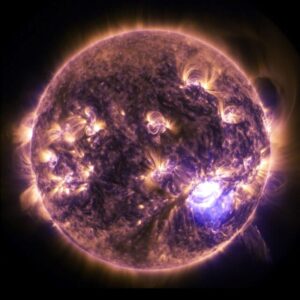
Recent images taken from Big Bear Solar Observatory of a massive section of the Sun's surface, about 23,000 miles square, showcase the advances in real-time clarity over vast distances presented by a groundbreaking new optics system.Credit: Image courtesy of...

Charon, a moon of Pluto. When Charon is positioned between the sun and Pluto, Georgia Tech research indicates that the moon can significantly reduce atmospheric loss. Credit: NASA-JHUAPL-SwRI
Pluto's relationship with its moon Charon is one of the more unusual...

A team of Israeli researchers suggests that the Moon we see every night is not Earth's first moon, but rather the last in a series of moons that orbited the Earth in the past.Credit: Flickr/costachico
The Moon, and the question...

This Chandra image of Sagitarrius A* and the surrounding region is based on data from a series of observations lasting a total of about one million seconds, or almost two weeks.Image Credit: Nasa
The supermassive black hole candidate at the...

This artist's conception portrays a collection of planet-mass objects that have been flung out of the galactic center at speeds of 20 million miles per hour (10,000 km/s). These cosmic "spitballs" formed from fragments of a star that was...

NGC 1448, a galaxy with an active galactic nucleus hidden by gas and dust, is seen in this image. Credit: Carnegie-Irvine Galaxy Survey/NASA/JPL-Caltech
Monster black holes sometimes lurk behind gas and dust, hiding from the gaze of most telescopes. But...


