


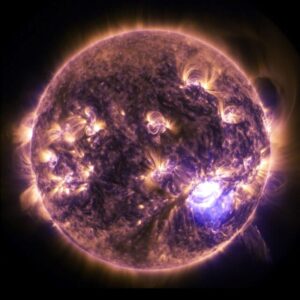


For the first time, astronomers have observed a star pulsing in response to its orbiting planet. The star, HAT-P-2, pictured, is one of the most massive exoplanets known today. The planet, named HAT-P-2b, tracks its star in a highly...

Artist's conceptions of the probable planet orbiting a star called GJ 411. Credit: Ricardo Ramirez.
An international team of astronomers released the largest-ever compilation of exoplanet-detecting observations made using a technique called the radial velocity method. They demonstrated how these...

Image credit: ESA/Hubble & NASA. Text credit: European Space Agency
The Andromeda constellation is one of the 88 modern constellations and should not be confused with our neighboring Andromeda Galaxy. The Andromeda constellation is home to the pictured galaxy known...

A still image from a computer simulation of an oscillon, a strong localized fluctuation of the inflaton field of the early universe. According to the calculations of Prof. Stefan Antusch and his team, oscillons produced a characteristic peak in...

Image credit: ESA/Hubble & NASA, Acknowledgement: Matej Novak. Text credit: European Space Agency
A dying star’s final moments are captured in this image from the NASA/ESA Hubble Space Telescope. The death throes of this star may only last mere moments...

By studying the magnetic orientations in ancient meteorites, an MIT team has determined that the solar nebula — the vast of disc of gas and dust that ultimately gave rise to the solar system — lasted around 3 to...

This artist's concept shows a massive, comet-like object falling toward a white dwarf. New Hubble Space Telescope findings are evidence for a belt of comet-like bodies orbiting the white dwarf, similar to our solar system's Kuiper Belt. The findings...

Galaxy Cluster MACS 0416. Credit: University of Texas at Austin
Astronomers at The University of Texas at Austin have developed a new technique to discover the faintest galaxies yet seen in the early universe —10 times fainter than any previously...

In this artist's illustration, an intermediate-mass black hole in the foreground distorts light from the globular star cluster in the background. New research suggests that a 2,200 solar-mass black hole resides at the center of the globular cluster 47...

Credit: NASA
The search for life beyond Earth starts in habitable zones, the regions around stars where conditions could potentially allow liquid water – which is essential for life as we know it – to pool on a planet's surface....

Credit: University of Warwick
An exotic binary star system 380 light-years away has been identified as an elusive white dwarf pulsar – the first of its kind ever to be discovered in the universe – thanks to research by the...


