




Visualizations of the simulated distributions of gas and stars in the Universe from data provided by Cosmowebportal: The cube represents a space section of the Universe (more than 300 million light years), the bright spots on the cube faces...

Earth observation of the space environment taken during a night pass by Dr. Kjell Lindgren of the Expedition 44 crew during Scott Kelly's One-Year Mission aboard the International Space Station (ISS). An aurora with purple and SSRMS arm are...

Artist's conception of the pair of supermassive black holes at the center of the galaxy 0402+379, 750 million light-years from Earth.
Credit: Josh Valenzuela/University of New Mexico
Using the supersharp radio "vision" of the National Science Foundation's Very Long Baseline Array...

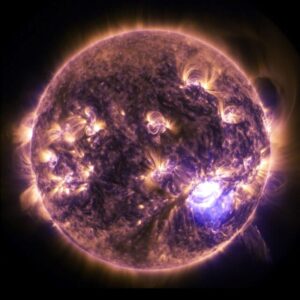
At any given moment, as many as 10 million wild jets of solar material burst from the sun's surface. They erupt as fast as 60 miles per second, and can reach lengths of 6,000 miles before collapsing. These are...

Protostar FIR 3 (HOPS 370) with outflow that may have triggered the formation of younger protostar FIR 4 (HOPS 108, location marked with red dot), in the Orion star-forming region. (au = astronomical unit, the distance from the Earth...

This sketch illustrates a family tree of exoplanets. Planets are born out of swirling disks of gas and dust called protoplanetary disks. The disks give rise to giant planets like Jupiter as well as smaller planets mostly between the...

This is an artist impression of chaotic magnetic field lines very near a newly emerging protostar.
Credit: NRAO/AUI/NSF; D. Berry
For decades, scientists thought that the magnetic field lines coursing around newly forming stars were both powerful and unyielding, working like...

Jupiter is not only the largest planet in our solar system, but it’s also the oldest, according to new research from Lawrence Livermore National Laboratory.
Credit: Image courtesy of NASA
An international group of scientists has found that Jupiter is the...

MACS J0416.1-240 is a cluster of galaxies located four billion light years away. A new study based on observations with the Hubble Space Telescope has shown that the most massive galaxies in the universe, which are found in clusters...

The massive protostar is surrounded by a disk of gas and dust. The outflow is launched from the surface of the outer disk.
Credit: ALMA (ESO/NAOJ/NRAO)
Stars form from gas and dust floating in interstellar space. But, astronomers do not yet...

This illustration shows a red dwarf star orbited by a hypothetical exoplanet. Red dwarfs tend to be magnetically active, displaying gigantic arcing prominences and a wealth of dark sunspots. Red dwarfs also erupt with intense flares that could strip...


