


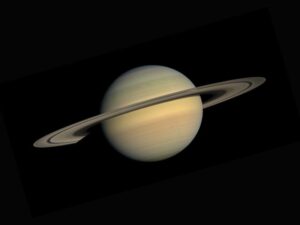



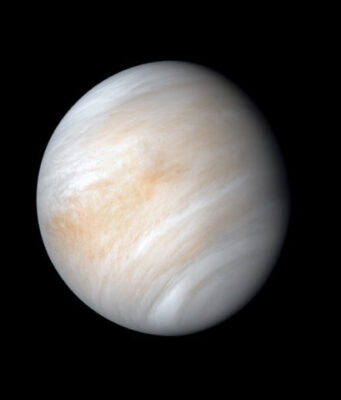

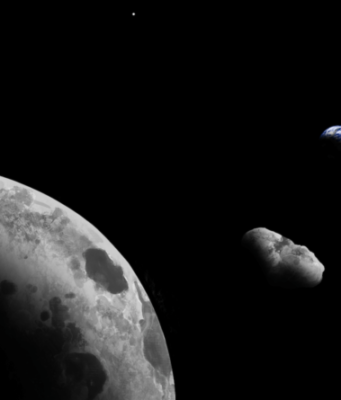

This illustration compares the four planets detected around the nearby star tau Ceti (top) and the inner planets of our solar system (bottom).
Credit: Illustration courtesy of Fabo Feng
A new study by an international team of astronomers reveals that four...

The newfound young star clusters lie thousands of light-years below the plane of our Milky Way galaxy, a flat spiral disk seen in this artist's conception. If alien lifeforms were to develop on planets orbiting these stars, they would...

An artist's concept of the distribution of the ambient gas around IRAS 16547-4247. The central high-density gas cloud is thought to contain multiple high-density protostars. Two outflows of gas spurt from the central part in the vertical and horizontal...

Observations of 'Jellyfish galaxies' with ESO's Very Large Telescope have revealed a previously unknown way to fuel supermassive black holes. It seems the mechanism that produces the tentacles of gas and newborn stars that give these galaxies their nickname...

These two views of Saturn's moon Titan exemplify how NASA's Cassini spacecraft has revealed the surface of this fascinating world.
Credit: NASA/JPL-Caltech/Space Science Institute
Mere weeks away from its dramatic, mission-ending plunge into Saturn, NASA's Cassini spacecraft has a hectic schedule,...

This dwarf galaxy is named NGC 5949. It sits at a distance of around 44 million light-years from Earth, placing it within the Milky Way's cosmic neighborhood.
Credit: ESA/Hubble & NASA
The universe is incomprehensibly vast, with billions of other planets...

Purdue University graduate student Katherine Fowee and postdoctoral research associate Anthony Cofer work on a new micropropulsion system for miniature satellites called CubeSats.
Credit: Purdue University photo/Erin Easterling
Habitat...

Images of Neptune taken during twilight observing revealed an extremely large bright storm system near Neptune's equator (labeled 'cloud complex' in the upper figure), a region where astronomers have never seen a bright cloud. The center of the storm...

Researchers have found that a "hot Jupiter" exoplanet named WASP-121b (left) has a stratosphere hot enough to boil iron. The planet is as close to its host star (right) as possible without the star's gravity ripping the planet apart.
Credit:...

This artist's impression shows a view of the surface of the planet Proxima b orbiting the red dwarf star Proxima Centauri, the closest star to the solar system.
Credit: ESO/M. Kornmesser
Proxima b, an Earth-size planet right outside our solar system...

This is the temperature of the surface around the southern pole of the moon according to LRO data.
Credit: NASA
Water reserves found on the moon are the result of asteroids acting as "delivery vehicles" and not of falling comets as...


