



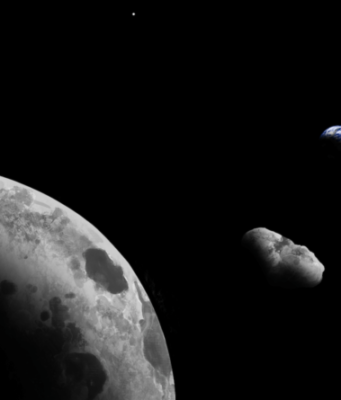

This artist's impression shows the binary asteroid 288P, located in the main asteroid belt between the planets Mars and Jupiter. The object is unique as it is a binary asteroid which also behaves like a comet. The comet-like properties...

NOAA's GOES-13 satellite captured this visible image of the massive Hurricane Sandy on Oct. 28 at 1302 UTC (9:02 a.m. EDT). The line of clouds from the Gulf of Mexico north are associated with the cold front that Sandy...

Sandia National Laboratories' Guillaume Loisel poses with Sandia's Z machine, where hands-on experiments contradicted a long-standing assumption about the X-ray spectra from the vicinity of black holes in space. Loisel is the lead author of a paper on the...

The difference in the magnitudes of supernovae in the ?CDM and Timescape cosmologies and the magnitudes the supernovae would appear to have in an empty universe (horizontal dashed line). Both models show recent apparent acceleration following earlier deceleration. In...

An artists impression of GJ 436b can be seen in the background in this image.
Credit: NASA/JPL-Caltech
Astronomers from the University of Geneva (UNIGE), Switzerland, also members of the PlanetS National Centre of Competence in Research, have been working on a...

AR Scorpii consists of a rapidly spinning, magnetized white dwarf star that mysteriously interacts with its companion star.
Credit: M. Garlick/University of Warwick, ESA/Hubble
Astronomers studying the unique binary star system AR Scorpii have discovered the brightness of the system has...

Submillimeter waves detected with ALMA are shown in the left, indicating the location of dense dust and gas where stars are being formed. Optical and infrared light seen with the Hubble Space Telescope are shown in the middle and...

Composite image of the X-ray pulsar SXP 1062 surrounded by the supernova remnant. The false-color image combines X-ray (blue) and optical data (oxygen: green, hydrogen: red).
Credit: ESA / XMM-Newton / L. Oskinova, University of Potsdam, Germany / M. Guerrero,...

The Low-Frequency Array (LOFAR), a network of thousands of linked radio antennas, primarily located in the Netherlands, has discovered two new millisecond pulsars by investigating previously unknown gamma-ray sources uncovered by NASA's Fermi Gamma-ray Space Telescope. Pulsar J0952-0607, highlighted...

A selfie of the NASA Curiosity rover at the Murray Buttes in Gale Crater, Mars, a location where boron was found in light-toned calcium sulfate veins.
Credit: NASA/JPL-Caltech/MSSS
The discovery of boron on Mars gives scientists more clues about whether life...

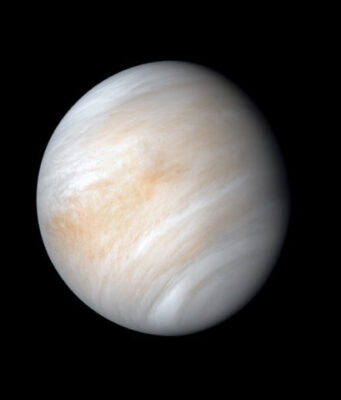
An illustration of Akatsuki successfully tracking lower-altitude clouds during the night with its near-infrared camera IR2.
Credit: Copyrighted image; PLANET-C Project Team
Observations by Japan's Venus climate orbiter Akatsuki have revealed an equatorial jet in the lower to middle...


