






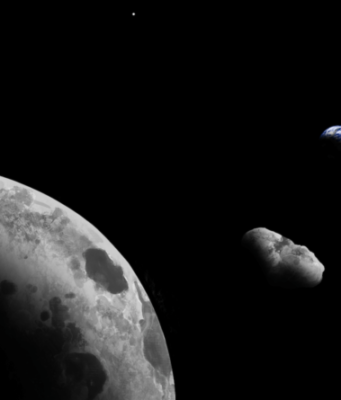

The South Pole-Aitken basin is the darker area at the bottom of this image.
Credit: Photo by NASA/Goddard Space Flight CenterScientific Visualization Studio
Scientists have long assumed that all the planets in our solar system look the same beneath the surface,...

This artist's rendering shows a large exoplanet causing small bodies to collide in a disk of dust.
Credit: NASA/JPL-Caltech
There's no map showing all the billions of exoplanets hiding in our galaxy -- they're so distant and faint compared to their...

Artist concept of Haumea, with the correct proportions of the main body and the ring. The ring is at a distance of 2287 kilometers from the center of the main body and is darker than the surface of the...

NASA's Cassini spacecraft is shown during its Sept. 15, 2017, plunge into Saturn's atmosphere in this artist's depiction.
Credit: NASA/JPL-Caltech
As NASA's Cassini spacecraft made its fateful dive into the upper atmosphere of Saturn on Sept. 15, the spacecraft was live-streaming...

Sun-like star Kronos shows signs of having ingested 15 Earth masses worth of rocky planets, prompting Princeton astronomers to nickname it for the Titan who ate his young. This artist's rendering of the diverse rocky planets in our galaxy...

Astronomers directly measured the distance to a region on the far side of our Milky Way Galaxy, past the Galaxy's center.
Credit: Bill Saxton, NRAO/AUI/NSF; Robert Hurt, NASA.
Astronomers using the National Science Foundation's Very Long Baseline Array (VLBA) have directly...

Titan, Saturn's largest moon, behind the planet's rings. The much smaller moon Epimetheus is visible in the foreground.
Credit: NASA/JPL/Space Science Institute
Titan, the largest of Saturn's more than 60 moons, has surprisingly intense rainstorms, according to research by a team...

This illustration depicts a hypothetical uneven ring of dust orbiting a mysterious dimming star about 1,000 light years from Earth.
Credit: Image by NASA/JPL-Caltech
Massimo Marengo's work in stellar astrophysics keeps returning to the mysterious dimming of Tabby's star some 1,000...

In the image above obtained with the NASA's spectrograph IRIS, can be seen in the bedge or limbo of the Sun the multitude of jets leaping the surface. In the center image, the numerical model is able to reproduce...

This image shows V1247 Orionis, a young, hot star surrounded by a dynamic ring of gas and dust, known as a circumstellar disc. The disc can be seen in two parts: a clearly defined central ring of matter and...

The NASA-funded FOXSI instrument captured new evidence of small solar flares, called nanoflares, during its December 2014 flight on a suborbital sounding rocket. Nanoflares could help explain why the Sun's atmosphere, the corona, is so much hotter than the...


