



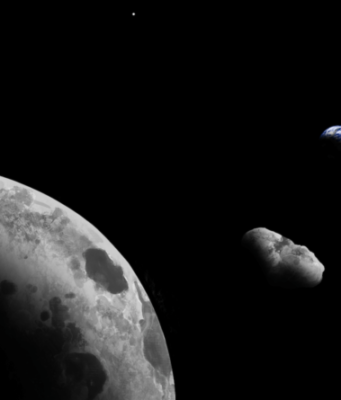

This artist's impression shows the first interstellar asteroid: `Oumuamua. This unique object was discovered on Oct. 19, 2017 by the Pan-STARRS 1 telescope in Hawai`i. Subsequent observations from ESO's Very Large Telescope in Chile and other observatories around the...

This simulation shows how bubbles form over the course of 4.7 million years from the intense stellar winds off a massive star. UChicago scientists postulated how our own solar system could have formed in the dense shell of such...

Climate patterns on Jupiter can have striking similarities to those on Earth, making the gas giant a natural laboratory for understanding planetary atmospheres.
Credit: NASA SVS/CI, Dan Gallagher
Speeding through the atmosphere high above Jupiter's equator is an east-west jet stream...

Yale astronomers have taken a fresh look at the nearby Alpha Centauri star system.
Credit: Illustration by Michael S. Helfenbein
Yale astronomers have taken a fresh look at the nearby Alpha Centauri star system and found new ways to narrow the...

With the discovery of an eighth planet, the Kepler-90 system is the first to tie with our solar system in number of planets. Artist's concept.
Credit: NASA/Ames Research Center/Wendy Stenzel
Our solar system now is tied for most number of planets...

Our home Milky Way galaxy (MW, yellow) and our companion Andromeda galaxy (M31, red) are participating in a downward flow away from a vast underdense region called the Local Void and toward the Virgo Cluster, represented by the purple...

A NASA-led team of scientists determined that WASP-18b, a 'hot Jupiter' located 325 light-years from Earth, has a stratosphere that's loaded with carbon monoxide, or CO, but has no signs of water.
Credit: NASA's Goddard Space Flight Center
A NASA-led team...

Artist impression of a pair of galaxies from the very early universe.
Credit: NRAO/AUI/NSF; D. Berry
Astronomers expect that the first galaxies, those that formed just a few hundred million years after the Big Bang, would share many similarities with some...

Mars may have been enveloped in a thick, steamy atmosphere as the planet's crust cooled and solidified. That steam bath could have created many of the clay mineral deposits that have long been attributed to water flow on or...

The ESO 3.6-metre telescope at La Silla.
Credit: Y. Beletsky (LCO)/ESO
New research using data collected by the European Southern Observatory (ESO) has revealed that a little-known exoplanet called K2-18b could well be a scaled-up version of Earth.
Just...

This is an artist's impression of TRAPPIST 1d (right) and its host star TRAPPIST 1 (left). The new research shows how planets like this could hide traces of life from astronomers' observations.
Credit: MPIA Graphics Department
New simulations show that the...


