



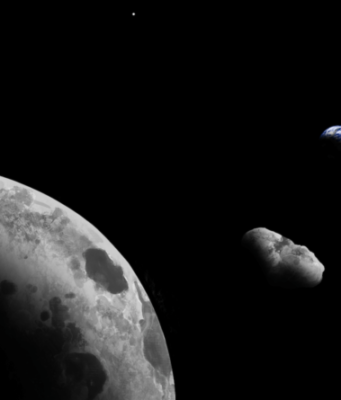

In popular culture, asteroids play the role of apocalyptic threat, get blamed for wiping out the dinosaurs - and offer an extraterrestrial source for mineral mining.
But for researcher Nicholas Hud, asteroids play an entirely different role: that of time...

Based on data from NASA's K2 mission, an international team of scientists has confirmed nearly 100 new exoplanets. This brings the total number of new exoplanets found with the K2 mission up to almost 300.
"We started out analyzing 275...

Three billion miles away on the farthest known major planet in our solar system, an ominous, dark storm - once big enough to stretch across the Atlantic Ocean from Boston to Portugal - is shrinking out of existence as...

A new simulation of supermassive black holes—the behemoths at the centers of galaxies—uses a realistic scenario to predict the light signals emitted in the surrounding gas before the masses collide, said Rochester Institute of Technology researchers.
The RIT-led study represents...

The shower of electrons bouncing across Earth's magnetosphere -- commonly known as the Northern Lights -- has been directly observed for the first time by an international team of scientists. While the cause of these colorful auroras has long...

Almost all galaxies hold concealed monstrous black holes in their centers. Researchers have known for a long time that the more massive the galaxy is, the more massive the central black hole is. This sounds reasonable at first, but...

A hole at the heart of a stunning rose-like interstellar cloud has puzzled astronomers for decades. But new research, led by the University of Leeds, offers an explanation for the discrepancy between the size and age of the Rosetta...

The first discovered interstellar visitor to our solar system has had a violent past, which is causing it to tumble around chaotically, a Queen's University Belfast scientist has discovered.
'Oumuamua flew through our solar system in October and was originally...

NASA's New Horizons spacecraft recently turned its telescopic camera toward a field of stars, snapped an image – and made history.
The routine calibration frame of the "Wishing Well" galactic open star cluster, made by the Long Range Reconnaissance Imager...

The universe is highly magnetic, with everything from stars to planets to galaxies producing their own magnetic fields. Astrophysicists have long puzzled over these surprisingly strong and long-lived fields, with theories and simulations seeking a mechanism that explains their...

A star about 100 light years away in the Pisces constellation, GJ 9827, hosts what may be one of the most massive and dense super-Earth planets detected to date according to new research led by Carnegie's Johanna Teske. This...


