



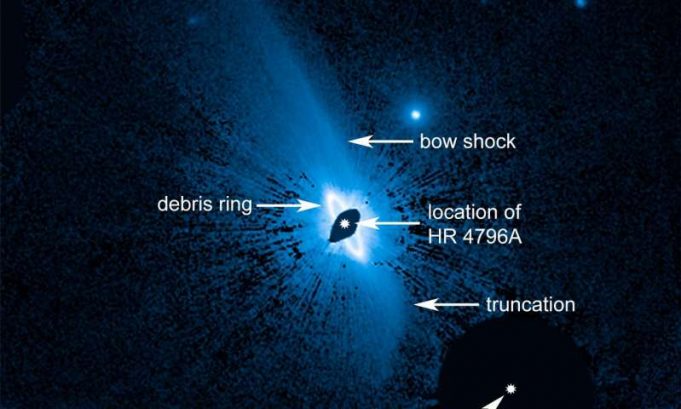
Astronomers have used NASA's Hubble Space Telescope to uncover a vast, complex dust structure, about 150 billion miles across, enveloping the young star HR 4796A. A bright, narrow, inner ring of dust is already known to encircle the star...
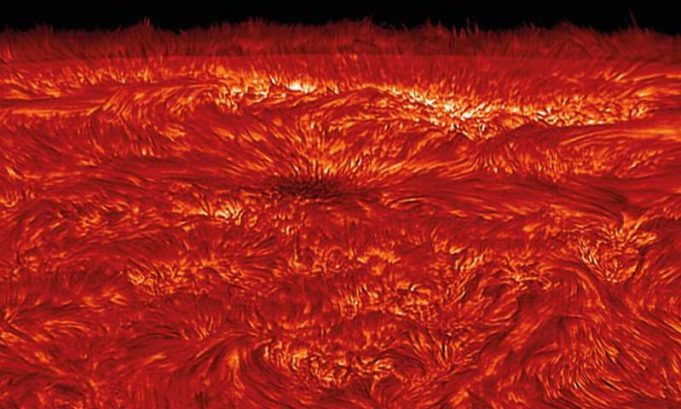
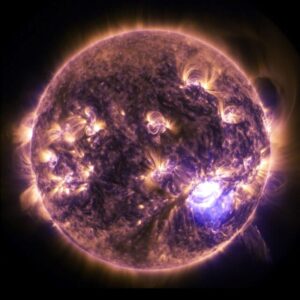
Scientists at Queen's University Belfast have led an international team to the ground-breaking discovery that magnetic waves crashing through the sun may be key to heating its atmosphere and propelling the solar wind.
The sun is the source of energy...
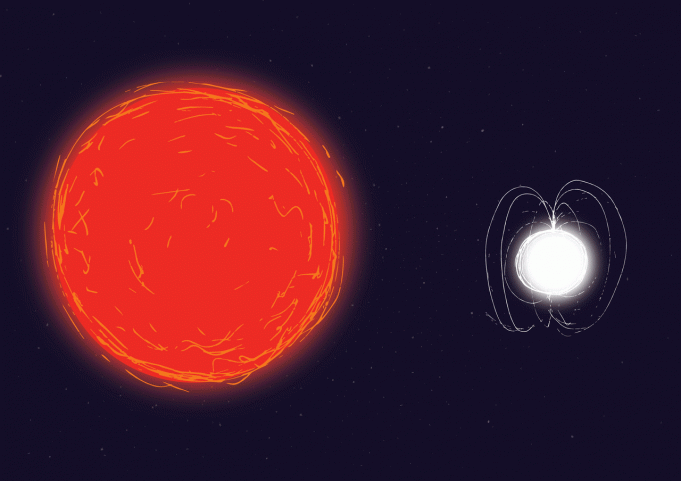
ESA's Integral space observatory has witnessed a rare event: the moment that winds emitted by a swollen red giant star revived its slow-spinning companion, the core of a dead star, bringing it back to life in a flash of...

Scientists have used lab experiments to retrace the chemical steps leading to the creation of complex hydrocarbons in space, showing pathways to forming 2-D carbon-based nanostructures in a mix of heated gases.
The latest study, which featured experiments at the...

Quantum mechanics is the branch of physics governing the sometimes-strange behavior of the tiny particles that make up our universe. Equations describing the quantum world are generally confined to the subatomic realm -- the mathematics relevant at very small...
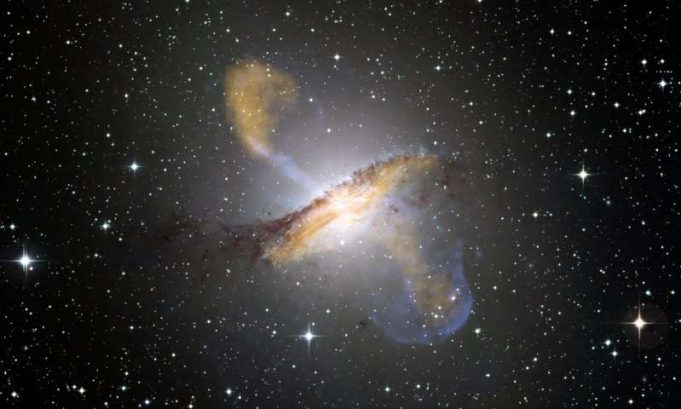
Supermassive black holes, which lurk at the heart of most galaxies, are often described as "beasts" or "monsters". But despite this, they are pretty much invisible. To show that they are there at all, astronomers typically have to measure...
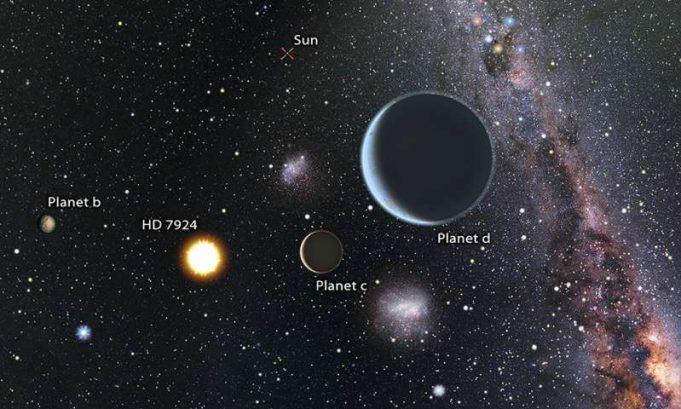
Over 3500 extra-solar planets have been confirmed to date. Most of them were discovered using the transit method, and astronomers can combine the transit light curves with velocity wobble observations to determine the planet's mass and radius, and thereby...

A research team of multiple institutes, including the National Astronomical Observatory of Japan and University of Tokyo, released an unprecedentedly wide and sharp dark matter map based on the newly obtained imaging data by Hyper Suprime-Cam on the Subaru...
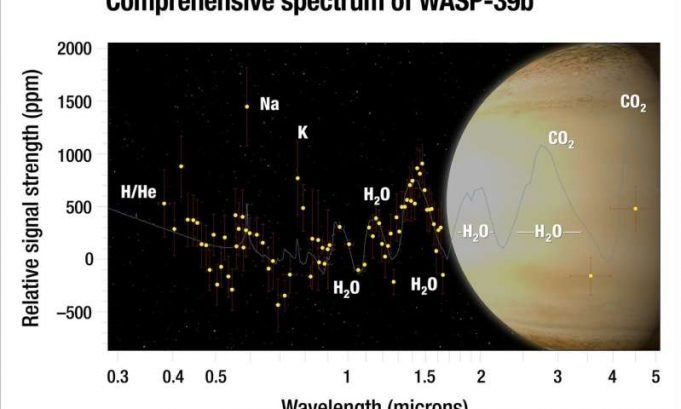
Much like detectives study fingerprints to identify the culprit, scientists used NASA's Hubble and Spitzer space telescopes to find the "fingerprints" of water in the atmosphere of a hot, bloated, Saturn-mass exoplanet some 700 light-years away. And, they found...

An international team of scientists has used the NASA/ESA Hubble Space Telescope to study the atmosphere of the hot exoplanet WASP-39b. By combining this new data with older data they created the most complete study yet of an exoplanet...

Long ago, about 400,000 years after the beginning of the universe (the Big Bang), the universe was dark. There were no stars or galaxies, and the universe was filled primarily with neutral hydrogen gas.
Then, for the next 50-100 million...


