




Using the extinct niobium-92 atom, ETH researchers have been able to date events in the early solar system with greater precision than before. The study concludes that supernova explosions must have taken place in the birth environment of our...

A study, led by researchers at the Instituto de Astrofísica de Canarias (IAC) and carried out with OSIRIS, an instrument on the Gran Telescopio Canarias (GTC), has found the most densely populated galaxy cluster in formation in the primitive...

While protons populate the nucleus of every atom in the universe, sometimes they can be squeezed into a smaller size and slip out of the nucleus for a romp on their own. Observing these squeezed protons may offer unique...

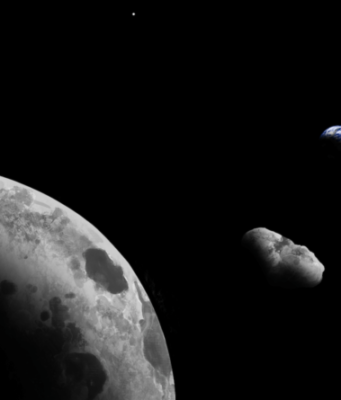
After traveling several billion miles toward the Sun, a wayward young comet-like object orbiting among the giant planets has found a temporary parking place along the way. The object has settled near a family of captured ancient asteroids, called...

To come into being, galaxies need a steady diet of cold gases to undergo gravitational collapse. The larger the galaxy, the more cold gas it needs to coalesce and to grow.
Massive galaxies found in the early universe needed a...

A new theoretical study has proposed a novel mechanism for the creation of supermassive black holes from dark matter. The international team find that rather than the conventional formation scenarios involving 'normal' matter, supermassive black holes could instead form...
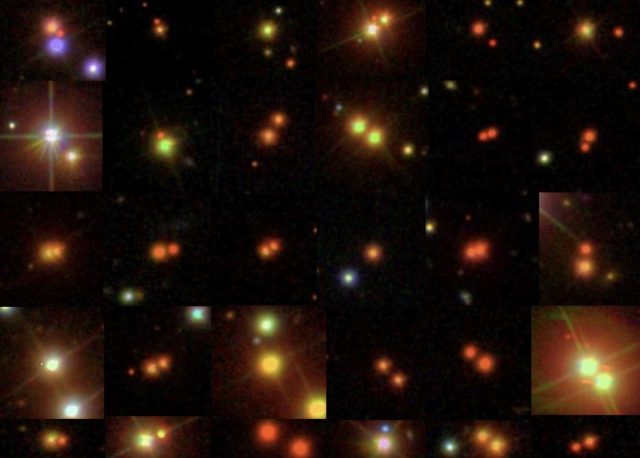
The latest star data from the Gaia space observatory has for the first time allowed astronomers to generate a massive 3D atlas of widely separated binary stars within about 3,000 light years of Earth -- 1.3 million of them.
The...

Astronomers have long been looking into the vast universe in hopes of discovering alien civilisations. But for a planet to have life, liquid water must be present. The likelihood of that scenario has seemed impossible to calculate because it...

Tracing back a ghostly particle to a shredded star, scientists have uncovered a gigantic cosmic particle accelerator. The subatomic particle, called a neutrino, was hurled towards Earth after the doomed star came too close to the supermassive black hole...

Fermilab scientists have been conducting experiments to look for quantum fluctuations of space and time at the smallest scale imaginable according to known physics. At this limit, the Planck length, our classical notions of space and time break down.
Imagine...

In a recent paper in the Proceedings of the National Academy of Sciences a group of researchers led by Maria Hjorth and Simon Albrecht from the Stellar Astrophysics Centre, Aarhus University, have published the discovery of a special exoplanetary system in...


