




A star that wanders too close to the supermassive black hole in the center of its galaxy will be torn apart by the black hole's gravity in a violent cataclysm called a tidal disruption event (TDE), producing a bright...

Iron-rich rocks near ancient lake sites on Mars could hold vital clues that show life once existed there, research suggests.
These rocks—which formed in lake beds—are the best place to seek fossil evidence of life from billions of years ago,...

Southwest Research Institute scientists integrated NASA's New Horizons discoveries with data from ESA's Rosetta mission to develop a new theory about how Pluto may have formed at the edge of our solar system.
"We've developed what we call 'the giant...

The presence of microbial life in Earth's stratosphere is not only opening up a new arena in which to study extremophiles, but is increasing the range of possible environments in which we may find life on other planets. This...

By looking at an ancient Martian meteorite that landed in the Sahara Desert, Lawrence Livermore National Laboratory (LLNL) scientists and collaborators have determined how and when the red planet's crustal topographic and geophysical divide formed.
Northwest Africa (NWA) 7034 is...

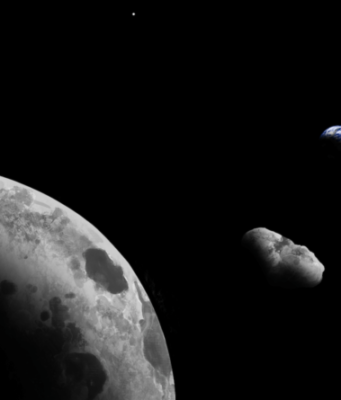
A new study has discovered the first known permanent immigrant to our Solar System. The asteroid, currently nestling in Jupiter's orbit, is the first known asteroid to have been captured from another star system. The work is published in...

A Yale-led research group has created the most detailed maps yet of a vast seedbed of stars similar to Earth's Sun.
The maps provide unprecedented detail of the structure of the Orion A molecular cloud, the closest star-forming region of...

In the western Utah desert, the Telescope Array sprawls across an area the size of New York City, waiting for cosmic rays. The facility detects the high-energy particles that collide with Earth's atmosphere constantly; the cosmic rays trigger the...
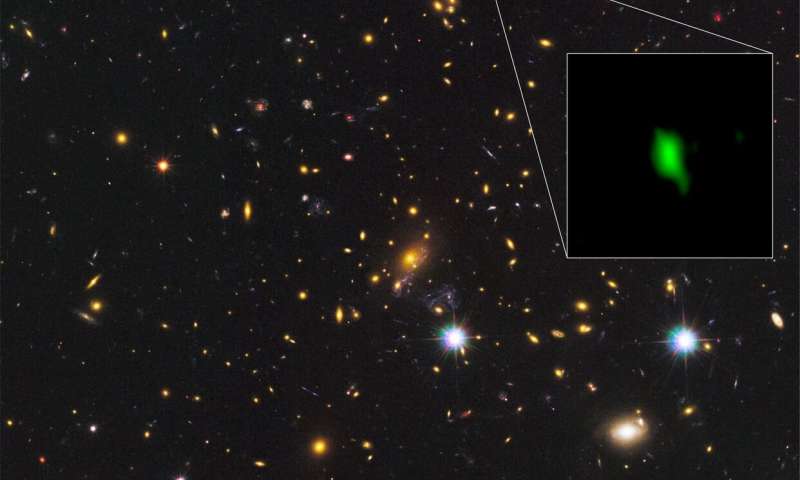
Not long after the Big Bang, the first generations of stars began altering the chemical make-up of primitive galaxies, slowly enriching the interstellar medium with basic elements such as oxygen, carbon, and nitrogen. Finding the earliest traces of these...

Astronomers have been keenly peering into M51, or the Whirlpool Galaxy, since the 1800s, its signature spiral structure informing the earliest debates over the nature of galaxies and the Cosmos at large.
But no one—not with the naked eye or...

Aspects of an otherwise Earthlike planet's tilt and orbital dynamics can severely affect its potential habitability—even triggering abrupt "snowball states" where oceans freeze and surface life is impossible, according to new research from astronomers at the University of Washington.
The...


