





A new study using data from NASA's NuSTAR space telescope suggests that Eta Carinae, the most luminous and massive stellar system within 10,000 light-years, is accelerating particles to high energies—some of which may reach Earth as cosmic rays.
"We know...

Uranus was hit by a massive object roughly twice the size of Earth that caused the planet to tilt and could explain its freezing temperatures, according to new research.
Astronomers at Durham University, UK, led an international team of experts...

A research team led by astronomers at the University of Warwick had to wait over 100 days for the sight of the first of confirmed neutron star merger to remerge from behind the glare of the sun.
They were rewarded...

Most asteroids and meteorites originate from the splintering of a handful of minor planets formed during the infancy of our solar system, a new study shows.
A study appearing online today in Nature Astronomy found at least 85 percent of...

Based on a new study of how near-Earth asteroid Phaethon reflects light at different angles, astronomers think that its surface may reflect less light than previously thought. This is an exciting mystery for the recently approved DESTINY+ mission to...
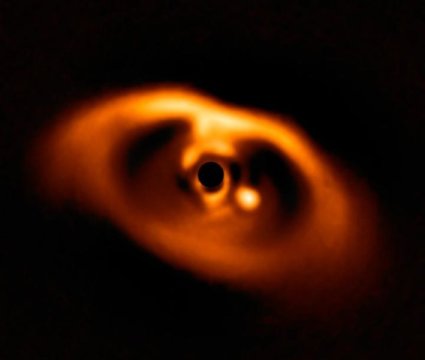
Astronomers led by a group at the Max Planck Institute for Astronomy in Heidelberg, Germany have captured a spectacular snapshot of planetary formation around the young dwarf star PDS 70. By using the SPHERE instrument on ESO's Very Large...

The surface of Mars bears imprints of structures that resemble fluvial steam networks on Earth. Scientists therefore assume that there must have been once enough water on the red planet to feed water streams that incised their path into...
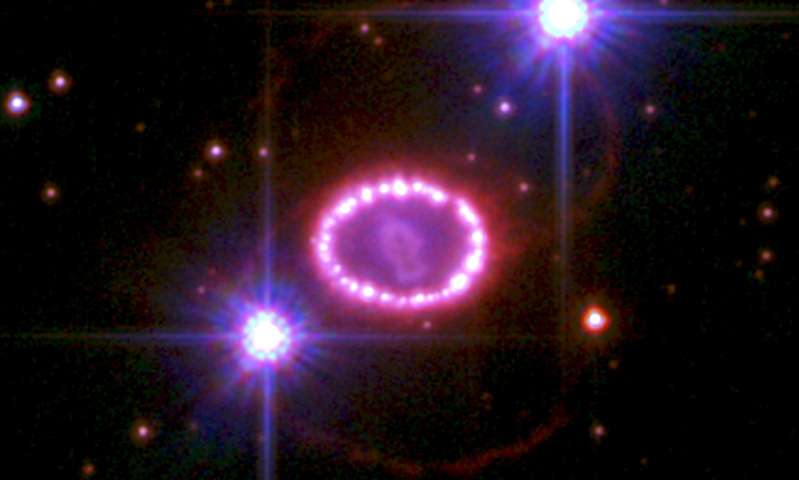
For the first time, astronomers have directly observed the magnetism in one of astronomy's most studied objects: the remains of Supernova 1987A (SN 1987A), a dying star that appeared in our skies over thirty years ago.
In addition to being...
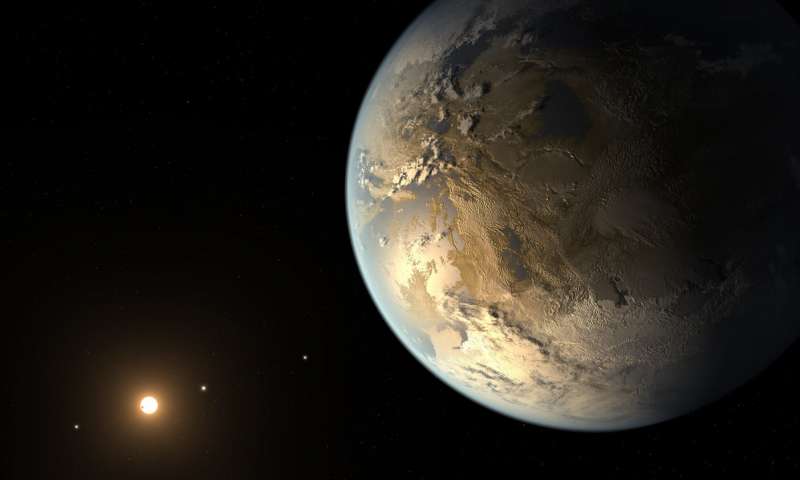
A new study from the Georgia Institute of Technology provides new clues indicating that an exoplanet 500 light-years away is much like Earth.
Kepler-186f is the first identified Earth-sized planet outside the solar system orbiting a star in the habitable...

Our galaxy is rich in grease-like molecules, according to an Australian-Turkish team. Astronomers at the University of New South Wales in Sydney (UNSW), and Ege University in Turkey used a laboratory to manufacture material with the same properties as...

`Oumuamua -- the first interstellar object discovered within our Solar System -- has been the subject of intense scrutiny since its discovery in October 2017 . Now, by combining data from the ESO's Very Large Telescope and other observatories,...


