




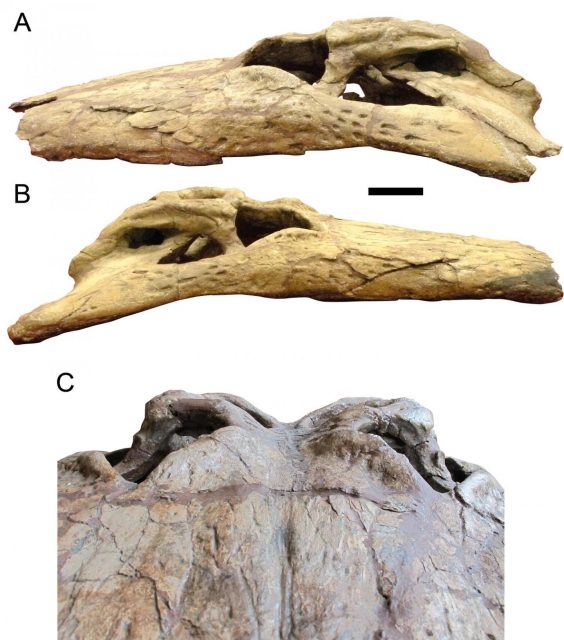
A new study, revisiting fossil specimens from the enormous crocodylian, Deinosuchus, has confirmed that the beast had teeth "the size of bananas," capable of taking down even the very largest of dinosaurs.
And, it wasn't alone!
The research, published in the Journal...

A fossil called Tanystropheus was first described in 1852, and it's been puzzling scientists ever since. At one point, paleontologists thought it was a flying pterosaur, like a pterodactyl, and that its long, hollow bones were phalanges in the finger that...

Texas researchers from the University of Houston, Baylor University and Texas A&M University have discovered evidence for why the earth cooled dramatically 13,000 years ago, dropping temperatures by about 3 degrees Centigrade.
The evidence is buried in a Central Texas...

Stonehenge, a Neolithic wonder in southern England, has vexed historians and archaeologists for centuries with its many mysteries: How was it built? What purpose did it serve? Where did its towering sandstone boulders come from?
That last question may finally...

Fossil remains of a novel species of lizard that lived more than 130 million years ago have been found in the north of Minas Gerais, Brazil. It has been named Neokotus sanfranciscanus and is the oldest representatives of the...

Have you ever wondered why human hands have five fingers? And what about amphibians? They usually only have four. Until now, researchers assumed that this was the case with the early ancestors of today's frogs and salamanders, the Temnospondyli....

A cave in a remote part of Mexico was visited by humans around 30,000 years ago—15,000 years earlier than people were previously thought to have reached the Americas.
Painstaking excavations of Chiquihuite Cave, located in a mountainous area in northern...

Homo Neanderthaliensis did not become extinct because of changes in climate. At least, this did not happen to the several Neanderthal groups that lived in the western Mediterranean 42,000 years ago. A research group of the University of Bologna...

A new method for estimating the biological sex of human remains based on reading protein sequences rather than DNA has been used to study an archeological site in Northern California. The protein-based technique gave superior results to DNA analysis...

New research has uncovered how an ancient human population adapted effectively to climate change, offering insights that are useful for the environmental challenges of today. The recent study examines the fishing patterns of prehistoric hunter-gatherers in Patagonia, a region...
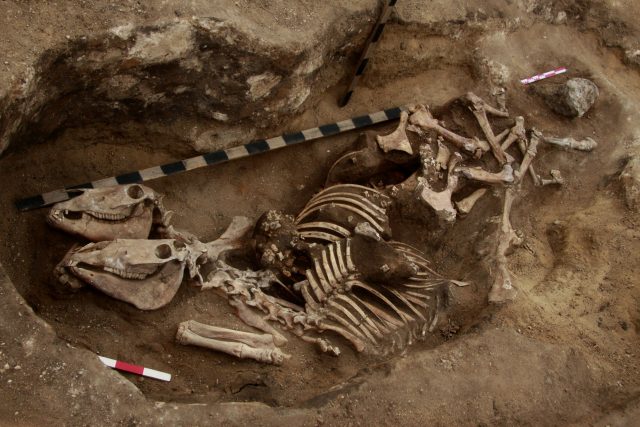
Scientists from South Ural State University (SUSU) have discovered new facts about the use of horses in the Bronze Age, working with materials from the monuments of Andronovo culture. As part of an international team from Kazakhstan, Russia, and...


