
science

New evidence suggests volcanoes caused biggest mass extinction ever

Researchers say mercury buried in ancient rock provides the strongest evidence yet that volcanoes caused the biggest mass extinction in the history of the...
Gravitational echo phenomenon will become a key to the new physics,...

Gravitational echoes may be caused by the collision of two black holes, and may indicate that these objects have completely new physical properties. This...
Best in snow: New scientific device creates electricity from snowfall

UCLA researchers and colleagues have designed a new device that creates electricity from falling snow. The first of its kind, this device is inexpensive,...
New study finds simple way to inoculate teens against junk food...

In a bid to fight obesity, public-health researchers have been trying for decades to find a way to convince teenagers to skip junk food...
Study: Aegean farmers replaced hunters of ancient Britain

A wave of migrants from what is now Greece and Turkey arrived in Britain some 6,000 years ago and virtually replaced the existing hunter-gatherer...
TESS finds its first Earth-sized planet
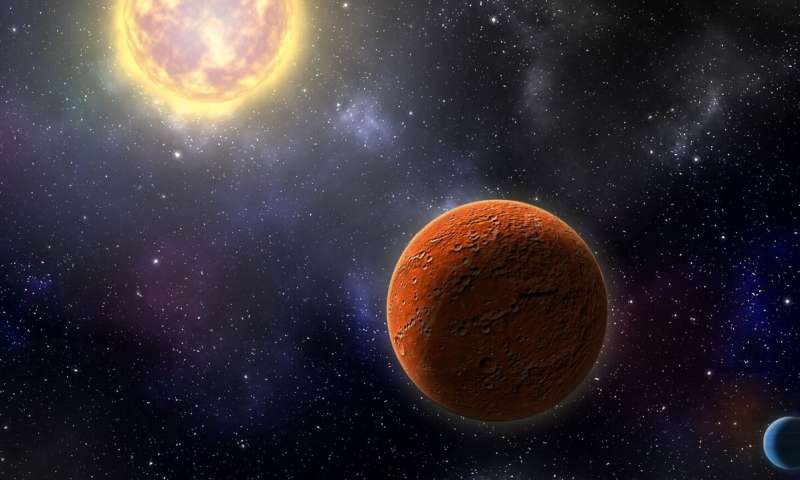
A nearby system hosts the first Earth-sized planet discovered by NASA's Transiting Exoplanets Survey Satellite, as well as a warm sub-Neptune-sized world, according to...
Need for social skills helped shape modern human face

As large-brained, short-faced hominins, our faces are different from other, now extinct hominins (such as the Neanderthals) and our closest living relatives (bonobos and chimpanzees), but...
Tiny fragment of a comet found inside a meteorite

A tiny piece of the building blocks from which comets formed has been discovered inside a primitive meteorite. The discovery by a Carnegie Institution...
To protect stem cells, plants have diverse genetic backup plans

Despite evolution driving a wide variety of differences, many plants function the same way. Now a new study has revealed the different genetic strategies...
The discrete-time physics hiding inside our continuous-time world

Scientists believe that time is continuous, not discrete—roughly speaking, they believe that it does not progress in "chunks," but rather "flows," smoothly and continuously....
Breezing through the space environment of Barnard’s Star b

The closest exoplanet to us, if we include only single stars like the Sun, is the planet around Barnard's Star, Barnard's Star-b ("BSb"). (The...


