

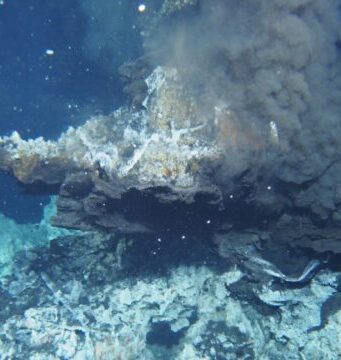
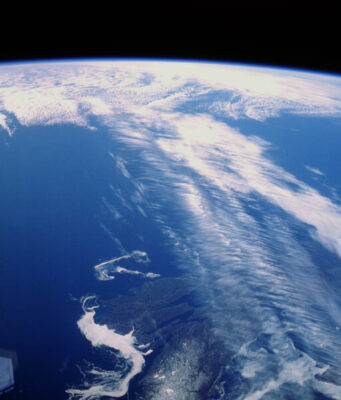


As slabs of Earth's crust decend into the mantle, they encounter a zone about 1,100 kilometers down where the mantle rock abruptly becomes stiffer, flowing less easily. Similarly, rising plumes of molten rock encounter the same layer and have...

This graphic demonstrates the intensity of the 2016 Atlantic storms.
Credit: Daniel Gessman and Chris Mehta, graduate students in the School of Geosciences, University of South Florida
The 2016 Hurricane Season is the longest hurricane season since 1951, making the 2016...

Oasis in Morocco (stock image).
Credit: © Laurens / Fotolia
An international team led by a researcher at Cardiff University believe that the movement of our ancestors across East Africa was shaped by the locations of groundwater springs.
In a new study,...

This is a view of the Mediano anticline, strata dipping to the left into the lake waters. This large-scale fold structure is a witness of ancient deformation associated with the rise of the Pyrenees in the middle Eocene, 45...

Volcano Mutnovsky Kamchatka, Russia. (Stock image)
Credit: © Tatiana / Fotolia
Geochemical fingerprinting links microscopic ash found on the bottom of a Svalbard lake to volcanic event happening 7000 years ago and 5000 km away.
Eruptions are cataclysmic events that may impact...

These are Ordovician-Silurian marine fossils from the museum of Tohoku University.
Credit: Kunio Kaiho
Researchers in the USA and Japan say they may have found the cause of the first mass extinction of life.
There have been five mass extinctions since the...

Earth's mantle information is shown.
Credit: University of Leicester
New insights into the convection patterns of the Earth's mantle and its chemical makeup have been revealed by a researcher from the University of Leicester.
The new findings suggest that the mantle does...

Twila Moon is pictured during field work to study ice-ocean interaction at the LeConte Glacier, Alaska.
Credit: Twila Moon/NSIDC
Glaciers around the world are disappearing before our eyes, and the implications for people are wide-ranging and troubling, Twila Moon, a glacier...

Spherical bubbles preserved in 3.48 billion-year-old rocks in the Dresser Formation in the Pilbara Craton in Western Australia provide evidence for early life having lived in ancient hot springs on land.
Credit: UNSW
Fossils discovered by UNSW scientists in 3.48 billion...

Calcite crystals precipitated in response to microbial activity. Tweezers shown for scale. Size of crystals ~5 mm (height).
Credit: Henrik Drake
It is becoming more and more appreciated that a major part of the biologic activity is not going on at...

Zircon crystals as old as 4.4 billion years were found in sandstone at Jack Hills of Western Australia.
Credit: Stuart Hay, ANU
Scientists at The Australian National University (ANU) say the early Earth was likely to be barren, flat and almost...


