



A University of Illinois-led team has identified unexpected geophysical signals underneath tectonically stable interiors of South America and Africa. The data suggest that geologic activity within stable portions of Earth's uppermost layer may have occurred more recently than previously...

For the first four billion years of Earth's history, our planet's continents would have been devoid of all life except microbes.
All of this changed with the origin of land plants from their pond scum relatives, greening the continents and creating habitats...

Overwhelming scientific evidence has demonstrated that our planet is getting warmer due to climate change, yet parts of the eastern U.S. are actually getting cooler. According to a Dartmouth-led study in Geophysical Research Letters, the location of this anomaly, known...

Efforts to stop human-caused earthquakes by shutting down wastewater injection wells that serve adjacent oil and gas fields may oversimplify the challenge, according to a new study from seismologists at Southern Methodist University, Dallas.
The seismologists analyzed a sequence of...

The biggest landslides on Earth aren't on land, but on the seafloor. These mega-slides can move thousands of cubic kilometers of material, and sometimes trigger tsunamis. Yet, remarkably, they occur on nearly flat slopes of less than three degrees.
Morelia...

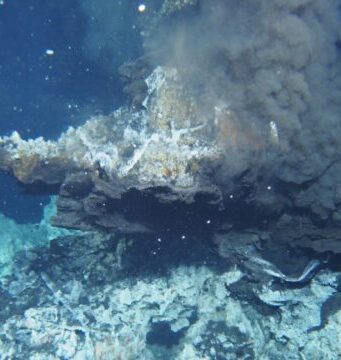
Some deep-sea skates -- cartilaginous fish related to rays and sharks -- use volcanic heat emitted at hydrothermal vents to incubate their eggs, according to a new study in the journal Scientific Reports. Because deep-sea skates have some of the...

The world's largest rivers begin in glaciated mountain regions. However, climate change may cause many glaciers to disappear. Will water become scarce?
There are around 200,000 glaciers worldwide. They play a central role in the water cycle, particularly in the...

Exciting new data on cave flora has been published today in PLOS ONE in a paper by researchers from the Royal Botanic Gardens, Kew and the Guangxi Institute of Botany in China.
Over five years (2009-2014) the researchers delved into the depths...

It is widely accepted that the Earth's inner core formed about a billion years ago when a solid, super-hot iron nugget spontaneously began to crystallize inside a 4,200-mile-wide ball of liquid metal at the planet's center.
One problem: That's not...

A record of volcanism preserved along ancient mid-ocean ridges provides evidence for heightened worldwide magmatic activity 66 million years ago just after the Chicxulub meteor struck Earth, according to University of Oregon scientists.
The research, published in Science Advances, points to...

The massive Toba volcanic eruption on the island of Sumatra about 74,000 years ago did not cause a six-year-long "volcanic winter" in East Africa and thereby cause the human population in the region to plummet, according to new University...


