



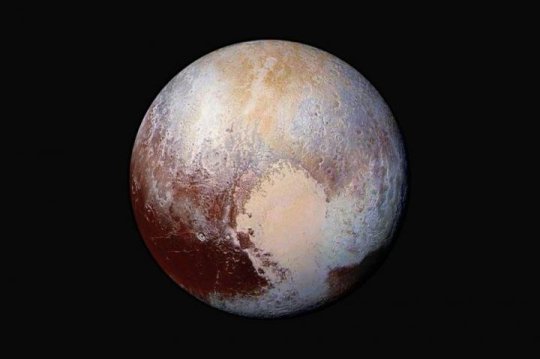
The reason Pluto lost its planet status is not valid, according to new research from the University of Central Florida in Orlando.
In 2006, the International Astronomical Union, a global group of astronomy experts, established a definition of a planet...
Austrian physicist Erwin Schrödinger (1887-1961), one of the giants of contemporary science, considered entanglement the most interesting property in quantum mechanics. In his view, it was this phenomenon that truly distinguished the quantum world from the classical world. Entanglement...

Astronomers have used NASA's Chandra X-ray Observatory to discover a ring of black holes or neutron stars in a galaxy 300 million light years from Earth.
This ring, while not wielding power over Middle Earth, may help scientists better understand...

Apart from a billion Milky Way stars, ESA's Gaia spacecraft also observes extragalactic objects. Its automated alert system notifies astronomers whenever Gaia spots a transient event. A team of astronomers have found out that by tweaking the existing automated...

Precise measurement using a continent-wide collection of National Science Foundation (NSF) radio telescopes has revealed that a narrow jet of particles moving at nearly the speed of light broke out into interstellar space after a pair of neutron stars...

A group of researchers led by Paula Sánchez-Sáez, a doctoral student in the Department of Astronomy of the Universidad de Chile, managed to determine that the rate of variability in the light emitted by material being swallowed by supermassive...
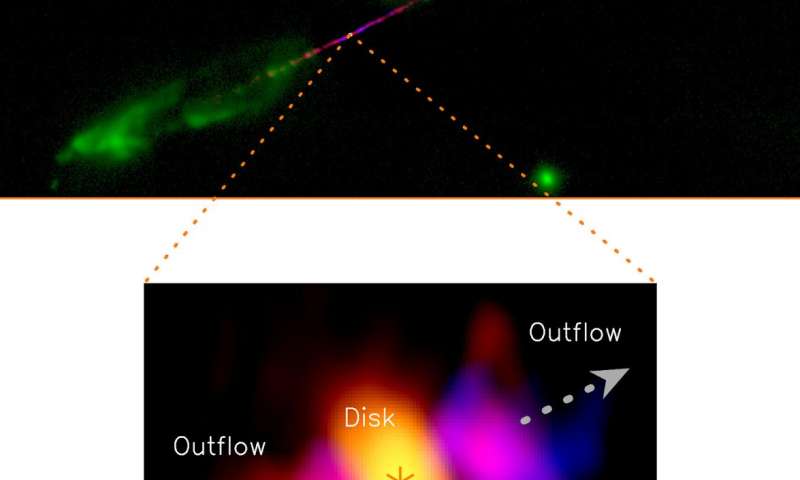
An international team led by Chin-Fei Lee at the Academia Sinica Institute of Astronomy and Astrophysics (ASIAA) has discovered a very small accretion disk formed around one of the youngest protostars, with the Atacama Large Millimeter/submillimeter Array (ALMA). This...

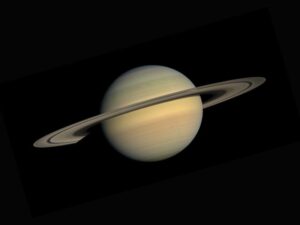
The long-lived international Cassini mission has revealed a surprising feature emerging at Saturn's northern pole as it nears summertime: a warming, high-altitude vortex with a hexagonal shape, akin to the famous hexagon seen deeper down in Saturn's clouds. This...

At the end of its life, a red supergiant star explodes in a hydrogen-rich supernova. By comparing observation results to simulation models, an international research team found that in many cases this explosion takes place inside a thick cloud...

The conditions for life surviving on planets entirely covered in water are more fluid than previously thought, opening up the possibility that water worlds could be habitable, according to a new paper from the University of Chicago and Pennsylvania...

An international team of astronomers from Japan, Mexico and the University of Massachusetts Amherst studying a "monster galaxy" 12.4 billion light years away today report that their instruments have achieved a 10 times higher angular resolution than ever before,...


