




The Hyades open star cluster in Taurus, one of the closest star clusters Astronomers using K2, the refurbished Kepler Space Telescope, studied solar-like oscillations in two stars in the cluster and used them to obtain stellar properties. Credit: Jerry...

The distorted galaxy in the simulation results from a collision between two galaxies, followed by them merging. Astronomers think such a merger could be the reason why SPT0346-52 is having such a boom of stellar construction. Once the two...

The constellation of Virgo (The Virgin) is especially rich in galaxies, due in part to the presence of a massive and gravitationally-bound collection of over 1300 galaxies called the Virgo Cluster. One particular member of this cosmic community, NGC...

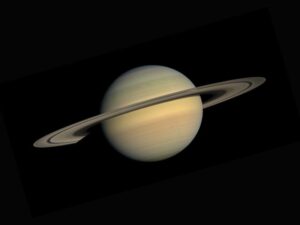
This view from NASA's Cassini spacecraft was obtained about two days before its first close pass by the outer edges of Saturn's main rings during its penultimate mission phase.Credits: NASA/JPL-Caltech/Space Science Institute
NASA's Cassini spacecraft has sent to Earth its...

Artistic design of the "superearth" GJ 536 b and the star GJ 536. Credit: Gabriel Pérez, SMM (IAC).
Doctoral student Alejandro Suárez Mascareño, of the Instituto de Astrofísica de Canarias (IAC) and the University of La Laguna (ULL), and his...

The Vela supercluster in its wider surroundings: The image displays the smoothed redshift distribution of galaxies in and around the Vela supercluster (larger ellipse; VSC). The centre of the image, so-called the Zone of Avoidance, is covered by the...

This cutaway image of Pluto shows a section through the area of Sputnik Planitia, with dark blue representing a subsurface ocean and light blue for the frozen crust. Credit: Pam Engebretson
Beneath Pluto's "heart" lies a cold, slushy ocean...

The star Kepler 11145123 is the roundest natural object ever measured in the universe. Stellar oscillations imply a difference in radius between the equator and the poles of only 3 km. This star is significantly more round than the...

A high-resolution digital elevation model derived from stereo images obtained by NASA's MESSENGER spacecraft has revealed Mercury's great valley shown here in this 3D perspective view.Credit: NASA/Johns Hopkins University Applied Physics Laboratory/Carnegie Institution of Washington/DLR/Smithsonian Institution
Scientists have discovered a...

An artist's impression shows a very distant quasar powered by a black hole with a mass two billion times that of the Sun. Credit: ESO/M. Kornmesser
Galaxies formed and grew billions of years ago by accumulating gas from their surroundings,...

Astronomers observed light from a quasar 8.5 billion years after it passed through distant galaxies.Credit: James Josephides and Professor Michael MurphyClose
Astronomers have precisely measured the strength of a fundamental force of Nature in a galaxy seen eight billion years...


