




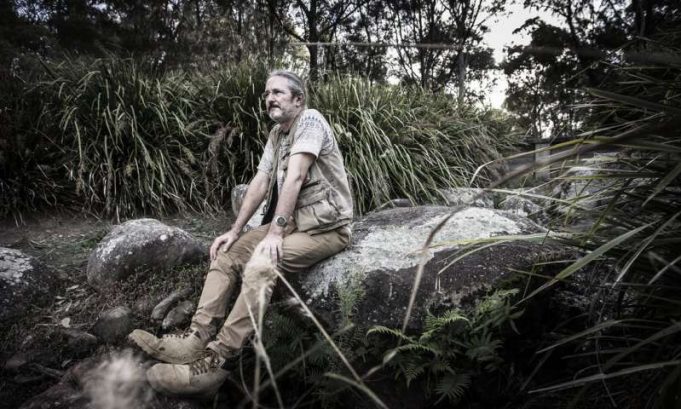
New archaeological evidence shows that humans were living in the Philippines by 709,000 years ago – hundreds of thousands of years earlier than previously thought.
Stone artefacts were found by an international team of researchers, including Dr. Gerrit "Gert" van...

For more than 200,000 years, Neanderthals successfully occupied the cold, dark forests and shores of Europe.
Then early humans came along.
Archaeological evidence suggests that human migrants from Africa arrived on the European continent around 40,000 years ago. About that same...

Rearing on its hind legs, the giant ground sloth would have been a formidable prey for anyone, let alone humans without modern weapons. Tightly muscled, angry and swinging its fore legs tipped with wolverine-like claws, it would have been...

An ancient horse burial at Tombos along the Nile River Valley shows that a member of the horse family thousands of years ago was more important to the culture than previously thought, which provides a window into human-animal relationships...

Trade and social networking helped our Homo sapiens ancestors survive a climate-changing volcanic eruption 40,000 years ago, giving hope that we will be able to ride out global warming by staying interconnected, a new study suggests.
Analyzing ancient tools, ornaments...
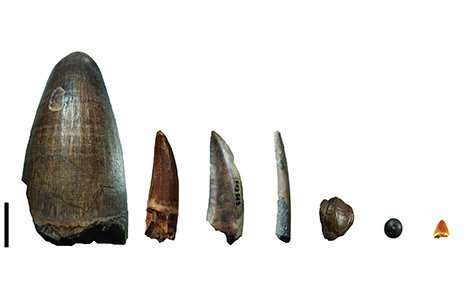
By studying calcium in fossil remains in deposits in Morocco and Niger, researchers have been able to reconstruct the food chains of the past, thus explaining how so many predators could coexist in the dinosaurs' time. This study, conducted...
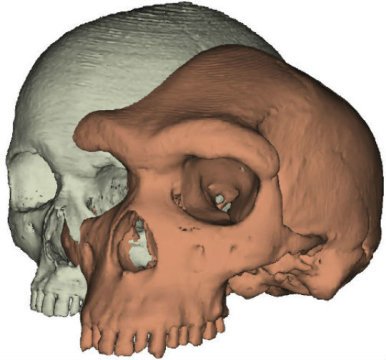
Highly mobile eyebrows that can be used to express a wide range of subtle emotions may have played a crucial role in human survival, new research from the University of York suggests.
Like the antlers on a stag, a pronounced...

Palaeontologists have discovered part of the skeleton of a 180 million-year-old pregnant ichthyosaur with the remains of between six and eight tiny embryos between its ribs.
The new specimen was studied by palaeontologists Mike Boyd and Dean Lomax from The...

Dozens of giant footprints discovered on a Scottish island are helping shed light on an important period in dinosaur evolution.
The tracks were made some 170 million years ago, in a muddy, shallow lagoon in what is now the north-east...

Careful examination of numerous fluted spear points found in Alaska and western Canada prove that the Ice Age peopling of the Americas was much more complex than previously believed, according to a study done by two Texas A&M University...
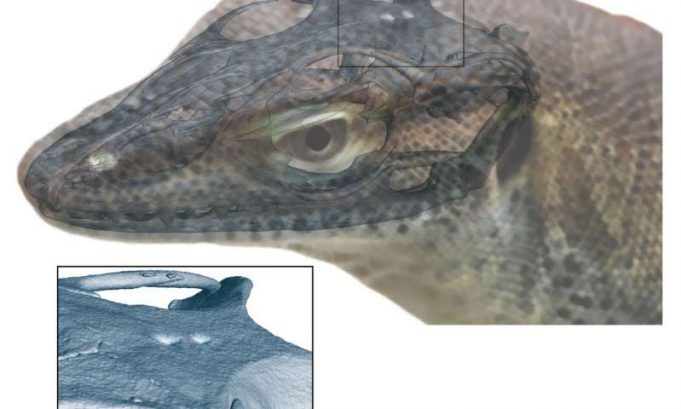
Researchers reporting in Current Biology on April 2 have evidence that an extinct species of monitor lizard had four eyes, a first among known jawed vertebrates. Today, only the jawless lampreys have four eyes.
The third and fourth eyes refer...


