





It was a prehistoric clash of the ages that didn't end pretty when a monster in the sky clashed with a beast of the deep.
The sorry outcome for one particular flying reptile is brutally recorded on a fossil where...

Scientists at the Department of Energy's Oak Ridge National Laboratory have created a recipe for a renewable 3-D printing feedstock that could spur a profitable new use for an intractable biorefinery byproduct: lignin.
The discovery, detailed in Science Advances, expands...

Early Jurassic predatory dinosaurs are very rare, and mostly small in size. Saltriovenator zanellai, a new genus and species described in the peer-reviewed journal PeerJ - the Journal of Life and Environmental Sciences by Italian paleontologists, is the oldest...

Scientists have described a fossil plant species that suggests flowers bloomed in the Early Jurassic, more than 174 million years ago, according to new research in the open-access journal eLife.
Before now, angiosperms (flowering plants) were thought to have a...

An international team of palaeontologists, which includes the University of Bristol, has discovered that the flying reptiles, pterosaurs, actually had four kinds of feathers, and these are shared with dinosaurs - pushing back the origin of feathers by some...

More than 85 well-preserved dinosaur footprints—made by at least seven different species—have been uncovered in East Sussex, representing the most diverse and detailed collection of these trace fossils from the Cretaceous Period found in the UK to date.
The footprints...
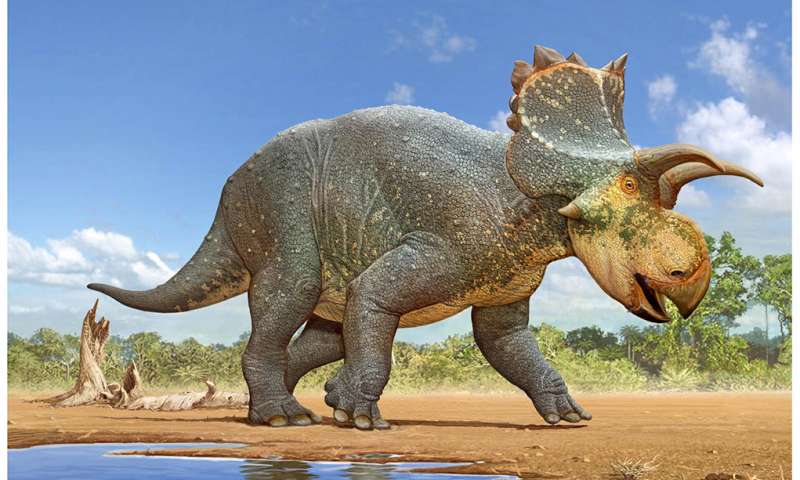
Palentologists are announcing a new dinosaur discovery in the southwest United States. Crittendenceratops krzyzanowskii is a new ceratopsid (horned) dinosaur from 73-million-year-old (Late Cretaceous) rocks in southern Arizona. It is one of the few dinosaurs named from Arizona.
Crittendenceratops krzyzanowskii...

The analysis of the world's most complete skeleton of an early human ancestor, conducted by a research collaboration involving the University of Liverpool, offers conclusive evidence that human ancestors became efficient upright walkers while they were still substantially tree...

An ancient, dolphin-like marine reptile resembles its distant relative in more than appearance, according to an international team of researchers that includes scientists from North Carolina State University and Sweden's Lund University. Molecular and microstructural analysis of a Stenopterygius...

Teilhardina brandti, a 56-million year-old primate found in Wyoming, may be older than its Asian cousin, previously thought to be the earliest ancestor of modern primates. Unusual tooth sockets in this lower jaw of Teilhardina brandti helped make the...

New research disputes a long-held view that our earliest tool-bearing ancestors contributed to the demise of large mammals in Africa over the last several million years. Instead, the researchers argue that long-term environmental change drove the extinctions, mainly in...


