





The discovery of the new species of dicraeosauridae, christened Bajadasaurus pronuspinax, was revealed in Scientific Reports.
A reproduction of its spiny neck was exhibited in the Cultural Science Center in Buenos Aires.
"We believe that the long and sharp spines—very long...

250 million years ago, it was covered in forests and rivers, and the temperature rarely dipped below freezing. It was also home to diverse wildlife, including early relatives of the dinosaurs. Scientists have just discovered the newest member of...

A much debated ancient human skull from Mongolia has been dated and genetically analysed, showing that it is the earliest modern human yet found in the region, according to new research from the University of Oxford. Radiocarbon dating and...
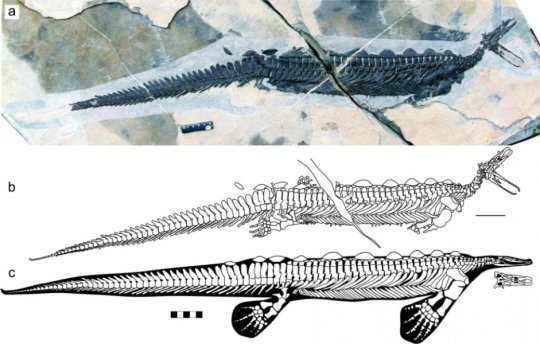
No animal alive today looks quite like a duckbilled platypus, but about 250 million years ago something very similar swam the shallow seas in what is now China, finding prey by touch with a cartilaginous bill. The newly discovered...

Neanderthals have been imagined as the inferior cousins of modern humans, but a new study by archaeologists at UCL reveals for the first time that they produced weaponry advanced enough to kill at a distance.
The study, published in Scientific...

Paleontologists at the University of Chicago have discovered the first detailed fossil of a hagfish, the slimy, eel-like carrion feeders of the ocean. The 100-million-year-old fossil helps answer questions about when these ancient, jawless fish branched off the evolutionary...

A mass of charred seeds found while clearing a home construction site in Brantford, Ontario, has been identified as ancient, domesticated goosefoot (C. berlandieri spp. jonesianum), a form of quinoa native to Eastern North America. The seeds date back...

During the European Middle Ages, literacy and written texts were largely the province of religious institutions. Richly illustrated manuscripts were created in monasteries for use by members of religious institutions and by the nobility. Some of these illuminated manuscripts...
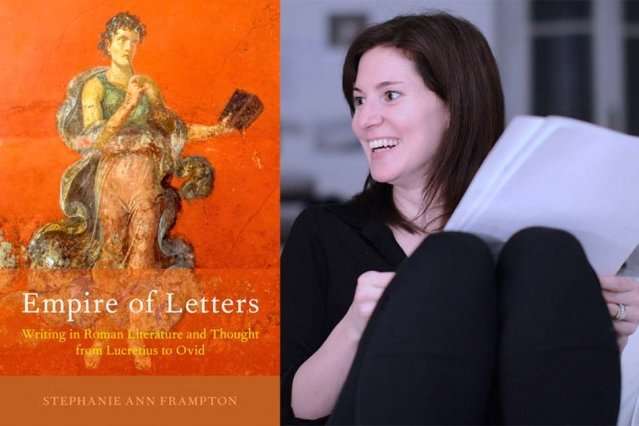
The Roman poet Lucretius' epic work "De rerum natura," or "On the Nature of Things," is the oldest surviving scientific treatise written in Latin. Composed around 55 B.C.E., the text is a lengthy piece of contrarianism. Lucreutius was in...

A "hidden cradle of plant evolution" has been uncovered in Jordan. In Permian sedimentary rocks exposed along the east coast of the Dead Sea, a team led by palaeobotanists from the University of Münster discovered well-preserved fossils of plant...

Using uranium-lead dating, Senckenberg scientists, in cooperation with an international team, were able to date the onset of the "Cambrian explosion" to precisely 538.8 million years ago. During the "Cambrian explosion," all currently known "blueprints" in the animal kingdom...


