




A wave of migrants from what is now Greece and Turkey arrived in Britain some 6,000 years ago and virtually replaced the existing hunter-gatherer population, according to a study published Monday in the journal Nature.
Scientists examining samples of ancient remains...

As large-brained, short-faced hominins, our faces are different from other, now extinct hominins (such as the Neanderthals) and our closest living relatives (bonobos and chimpanzees), but how and why did the modern human face evolve this way?
A new review published in Nature Ecology and...

It's widely accepted that anatomically modern humans interbred with their close relatives, the Neanderthals and Denisovans, as they dispersed out of Africa. But a study examining DNA fragments passed down from these ancient hominins to modern people living in...

An international team of researchers have uncovered the remains of a new species of human in the Philippines, proving the region played a key role in hominin evolutionary history.
The new species, Homo luzonensis is named after Luzon Island, where the more...

For the first time, a team of scholars and archaeologists has recorded and interpreted Cherokee inscriptions in Manitou Cave, Alabama. These inscriptions reveal evidence of secluded ceremonial activities at a time of crisis for the Cherokee, who were displaced...

An international team, led by an archaeologist from the University of Southampton and the University of Bordeaux, has revealed the first example of Palaeolithic figurative cave art found in the Balkan Peninsula.
Dr. Aitor Ruiz-Redondo worked with researchers from the...
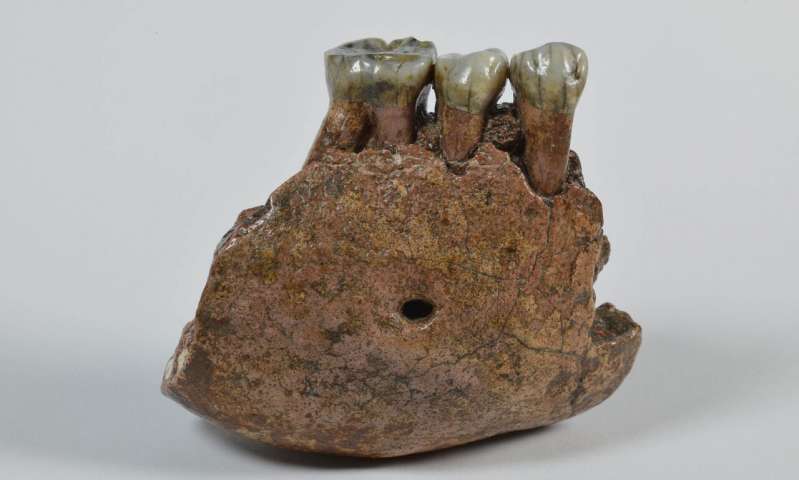
Together with an international team, Senckenberg scientists were able to document an additional fossil ape species in the Senckenberg hominid collection. The new species had already been described in 1950 as Meganthropus palaeojavanicus by Gustav Heinrich Ralph von Koenigswald,...

Paleontologists are used to finding dinosaur bones and tracks. But remnants of soft tissue, like muscles or skin, are rare and often not well preserved. A very small percentage of tracks – much less than 1% – show skin...

A newly identified species of 150 million-year-old marine crocodile has given insights into how a group of ancient animals evolved.
The ancestor of today's crocodiles belonged to a group of animals that developed a tail fin and paddle-like limbs for...

Cetaceans, the group including whales and dolphins, originated in south Asia more than 50 million years ago from a small, four-legged, hoofed ancestor. Now, researchers reporting the discovery of an ancient four-legged whale—found in 42.6-million-year-old marine sediments along the...

The chrome plating on the Terracotta Army bronze weapons—once thought to be the earliest form of anti-rust technology—derives from a decorative varnish rather than a preservation technique, finds a new study co-led by UCL and Terracotta Army Museum researchers.
The...


