




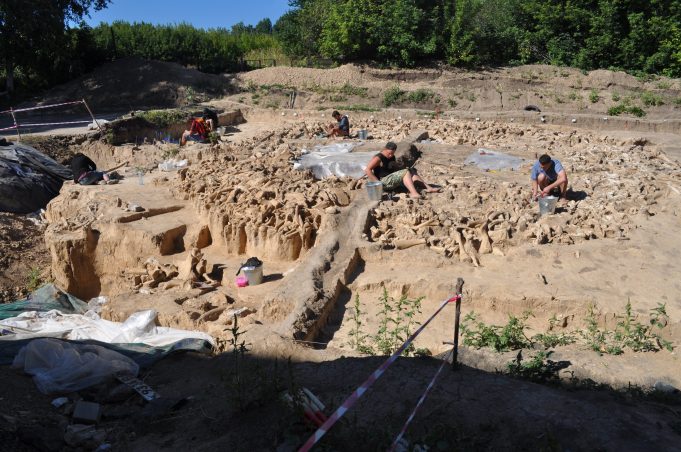
Mysterious bone circles made from the remains of dozens of mammoths have revealed clues about how ancient communities survived Europe's ice age.
About 70 of these structures are known to exist in Ukraine and the west Russian Plain.
New analysis shows...

A unique rock carving found in the Teymareh rock art site (Khomein county) in Central Iran with six limbs has been described as part man, part mantis. Rock carvings, or petroglyphs, of invertebrate animals are rare, so entomologists teamed...
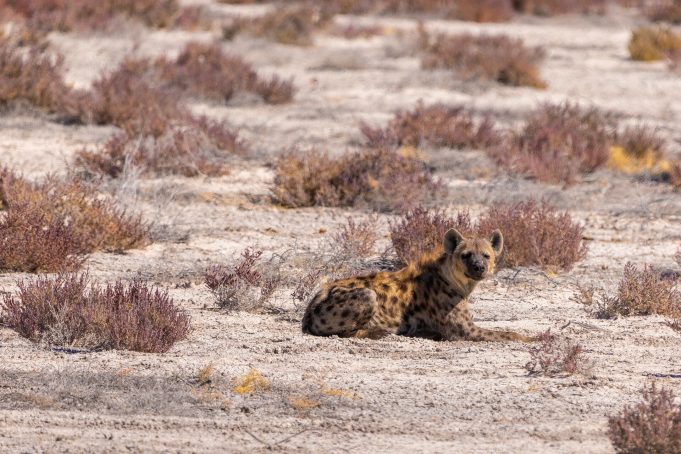
New research into the evolutionary history and prehistoric migrations of hyenas reveals surprising similarities between hyenas and prehistoric humans. The results from the University of Copenhagen and University of Potsdam also indicate that humans had a detrimental effect on...

Researchers at the Paul Scherrer Institute PSI have developed a new method to analyse particulate matter more precisely than ever before. Using it, they disproved an established doctrine: that molecules in aerosols undergo no further chemical transformations because they...

An international research team led by scientists from the U.S. and Spain, and including a University of Michigan geologist, has discovered a nearly complete cranium of an early human ancestor, estimated to about 1.5 million years ago, and a...

At least two different groups of Neanderthals lived in Southern Siberia and an international team of researchers including scientists from Friedrich-Alexander-Universität Erlangen-Nürnberg (FAU) have now proven that one of these groups migrated from Eastern Europe. The researchers have now...

Did a powerful queen of Cobá, one of the greatest cities of the ancient Maya world, build the longest Maya road to invade a smaller, isolated neighbor and gain a foothold against the emerging Chichén Itzá empire?
The question has...

In a study published in Nature Communications, researchers from the Max Planck Institute for the Science of Human History's Department of Archaeology, together with international partners, have presented evidence that Middle Palaeolithic tool users were present in India before and...
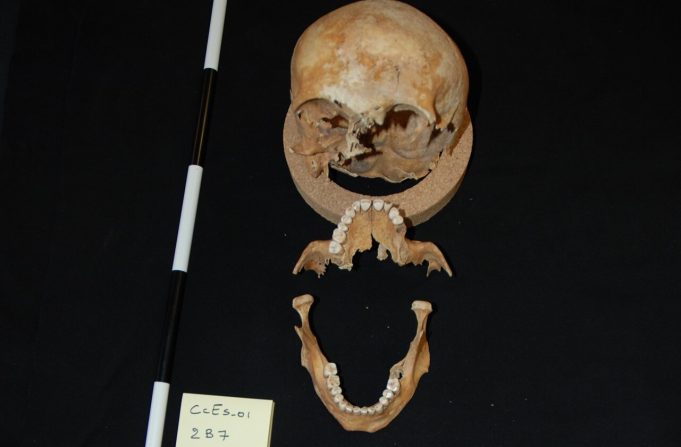
In Quebec, gravestones did not come into common use until the second half of the 19th century, so historical cemeteries contain many unmarked graves. Inspired by colleagues at Barcelona's Pompeu Fabra University, a team of researchers in genetics, archaeology...

A fossilised insect wing discovered in an abandoned mine in Labrador has led palaeontologists from McGill University and the University of Gda?sk to identify a new hairy cicada species that lived around 100 million years ago.
Maculaferrum blaisi, described in...

Catfish and tilapia make up many of the animal remains uncovered in the Saharan environment of the Takarkori rock shelter in southwestern Libya, according to a study published February 19, 2020 in the open-access journal PLOS ONE by Wim Van Neer...


