

science

Black hole ‘donuts’ are actually ‘fountains’

Based on computer simulations and new observations from the Atacama Large Millimeter/submillimeter Array (ALMA), researchers have found that the rings of gas surrounding active...
Scientists measure all of the starlight ever produced by the observable...

From their laboratories on a rocky planet dwarfed by the vastness of space, Clemson University scientists have managed to measure all of the starlight...
Oldest-known ancestor of modern primates may have come from North America,...

Teilhardina brandti, a 56-million year-old primate found in Wyoming, may be older than its Asian cousin, previously thought to be the earliest ancestor of...
Revealing hidden information in sound waves

By essentially turning down the pitch of sound waves, University of Michigan engineering researchers have devised a way to unlock greater amounts of data...
Scientists find a way to enhance the performance of quantum computers

USC scientists have demonstrated a theoretical method to enhance the performance of quantum computers, an important step to scale a technology with potential to...
High-speed camera shows incoming particles cause damage by briefly melting surfaces...

When tiny particles strike a metal surface at high speed—for example, as coatings being sprayed or as micrometeorites pummeling a space station—the moment of...
New catalyst material produces abundant cheap hydrogen

QUT chemistry researchers have discovered cheaper and more efficient materials for producing hydrogen for the storage of renewable energy that could replace current water-splitting...
Fossil algae reveal 500 million years of climate change

Earth scientists are able to travel far back in time to reconstruct the geological past and paleoclimate to make better predictions about future climate...
Atomic jet—the first lens for extreme-ultraviolet light developed

Scientists from the Max Born Institute (MBI) have developed the first refractive lens that focuses extreme ultraviolet beams. Instead of using a glass lens,...
NIST atomic clocks now keep time well enough to improve models...
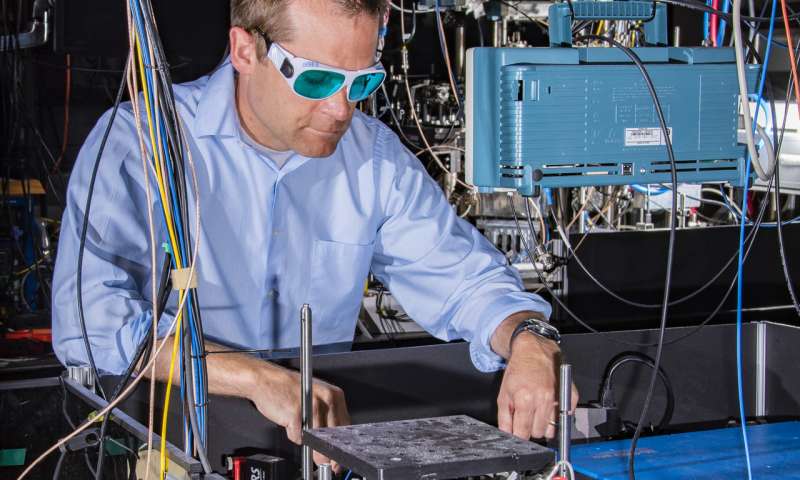
Experimental atomic clocks at the National Institute of Standards and Technology (NIST) have achieved three new performance records, now ticking precisely enough to not...
Study unlocks full potential of ‘supermaterial’ graphene

New research reveals why the "supermaterial" graphene has not transformed electronics as promised, and shows how to double its performance and finally harness its...


